In the world of heavy industrial construction, over 40% of projects suffer from critical schedule overruns caused by dimensional inaccuracies that demand costly on-site modifications. While standard structural steel and plate fabrication involves the cutting, bending, and welding of high-yield plates into load-bearing frameworks, the difference lies in execution. Our protocol eliminates field rework entirely by integrating rigorous thermal control with laser-verified tolerances, ensuring every engineered component fits perfectly the first time.
Why Standard Fabrication Fails Complex Industrial Specs
Procurement managers often select fabrication partners based on standard certifications, only to face catastrophic delays during assembly. Standard certifications guarantee basic competence, not project-specific engineering execution.
The Heavy Plate “Cold Cracking” Trap
High-yield steel plates like ASTM A514 or AR400 demand precise thermal management. Many standard fabricators ignore pre-heating requirements during groove cutting or winter transport. This negligence causes hydrogen embrittlement and microscopic cold cracks in the heat-affected zone. We implement continuous interpass temperature monitoring via digital thermal sensors, ensuring zero micro-fractures even in 4-inch thick plate weldments.
The Dimensional Distortion Dilemma
Heavy welding introduces massive heat input, naturally causing steel to warp. Inexperienced shops weld thick plates continuously without staggering the heat load, resulting in severe camber and sweep deviations. Our engineers calculate weld shrinkage allowances before striking an arc. We sequence weld passes and utilize robust strongbacks to lock components in place, guaranteeing bolt-hole alignments match your 3D models perfectly.
The “0-Rework Fabrication Pyramid”
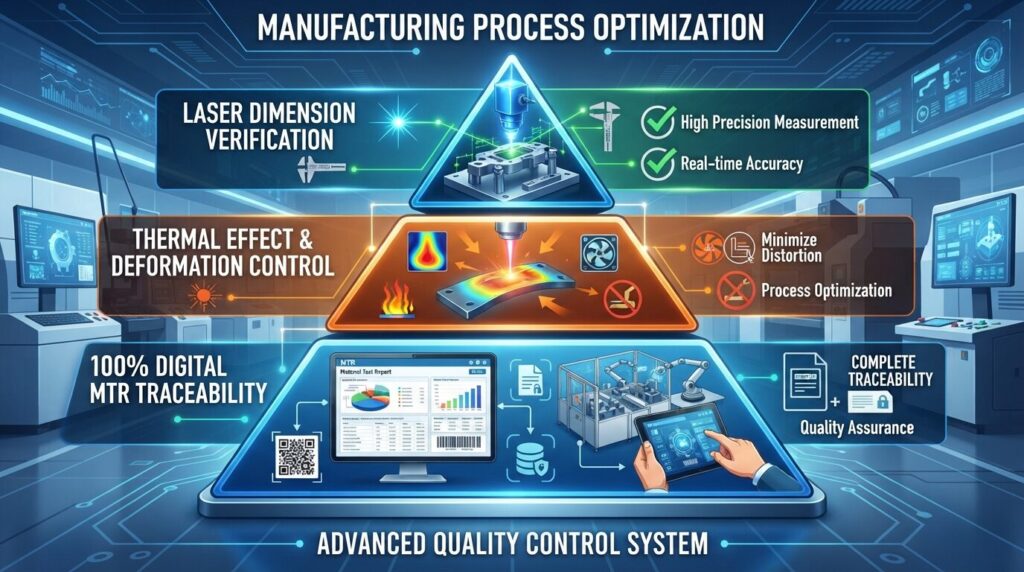
Our zero-rework guarantee stems from a proprietary three-step engineering framework designed specifically for heavy industrial applications.
Level 1: Absolute Material Traceability
Traceability prevents catastrophic liability during compliance audits. Before a single cut occurs, we digitize every Mill Test Report (MTR) and map it directly to the specific part number in the ERP system. Inspectors can scan a QR code on any finished beam or plate assembly to instantly view the original heat number, chemical composition, and exact origin of the raw material.
Level 2: Advanced Thermal & Deflection Control
Controlling heat input determines structural integrity. We utilize automated dual-torch robotic welding systems for deep-penetration joints on heavy plates. This method concentrates heat specifically at the root pass while minimizing the overall HAZ. Symmetrical welding sequences counteract natural distortion, keeping long-span girders straight within 1/16-inch tolerances.
Level 3: Micro-Tolerance Verification via 3D Scanning
Manual tape measures fail to capture complex geometric deviations in heavy plate fabrications. We deploy LiDAR-based 3D laser scanners to create digital twins of the finished assemblies. The software overlays the as-built scan onto your original CAD model, highlighting any deviations down to the millimeter before the component ever leaves our loading dock.
Advanced Capabilities in Plate Processing & Welding
Executing heavy industrial projects requires specific equipment capabilities that go far beyond standard steel framing.
High-Yield Plate Forming and Rolling
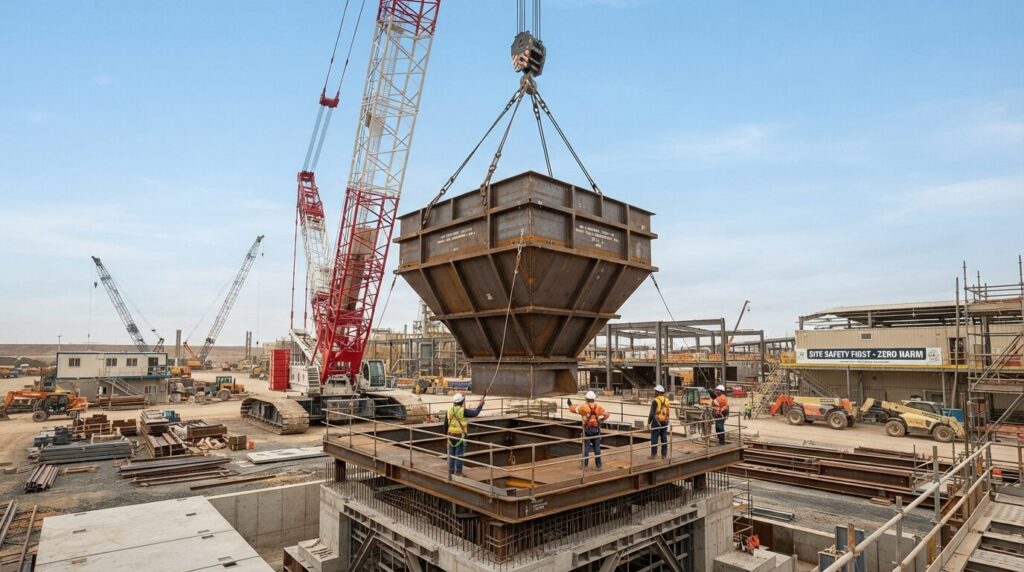
Rolling thick steel plates into perfect cylinders or cones requires immense hydraulic pressure and exact spring-back calculations. Our CNC plate rolls handle heavy materials without causing surface tearing or lamination issues. Operators adjust the pinch pressure dynamically based on the specific yield strength of that exact steel batch.
Accommodates high-yield structural steel (Pinch pressure dynamically adjusted per batch)
Full-Penetration Welds and NDT Upgrades
Critical load-bearing joints require flawless Complete Joint Penetration welds. We replace traditional X-ray testing with Phased Array Ultrasonic Testing. PAUT detects microscopic subsurface defects in extremely thick plates much faster than RT, creates a permanent digital record of the weld integrity, and eliminates radiation safety delays on the shop floor.
40% Installation Time Reduction
A major mining facility recently faced a 6-month delay because their previous supplier delivered primary crusher chutes with misaligned bolt patterns. The general contractor transferred the remaining fabrication scope to our team.
We analyzed the original drawings and identified design flaws causing post-weld distortion. Our engineering team added temporary bracing and adjusted the bevel angles for the plate connections. By applying our “0-Rework” framework, we delivered 450 tons of heavy plate fabrications. The site crews bolted every component together without a single field-welding modification, reducing their mechanical installation schedule by 40%.
FAQs
What is the difference between structural steel and plate fabrication?
Structural steel fabrication typically involves processing pre-shaped sections. Plate fabrication focuses on cutting, bending, and welding raw, flat metal sheets into custom shapes like tanks, hoppers, or heavy machine bases.
What welding standards apply to heavy plate fabrication?
Heavy industrial projects strictly require compliance with AWS D1.1 or ASME Section IX for pressure-retaining components. These codes govern welder qualifications, procedure specifications, and non-destructive testing requirements.
Why do you use PAUT instead of traditional X-ray for weld inspection?
PAUT detects lack of fusion and micro-cracks in thick plate welds more accurately than X-ray. It provides immediate digital mapping of the defect depth without the radiation hazards and evacuation requirements associated with traditional radiography.
How do you prevent distortion when welding thick steel plates?
We prevent distortion by calculating shrinkage allowances mathematically, strictly enforcing balanced welding sequences, utilizing heavy strongbacks, and controlling the heat input via automated welding parameters.
What is a Mill Test Report and why is it critical?
An MTR is a certified document from the steel mill detailing the chemical composition and physical properties of a specific batch of steel. It proves the material meets your engineering specifications. We maintain strict digital traceability mapping every MTR to the final fabricated part.
How much tolerance is acceptable in heavy structural steel & plate fabrication?
Standard tolerances follow AISC guidelines. However, for complex mechanical assemblies or moving parts, we utilize CNC machining post-fabrication to achieve micro-tolerances down to +/- 0.005 inches.
La razón fundamental por la que HP2202 puede abrirse paso es su presión de funcionamiento extremadamente estable de 1.3 ATA a 1.5 ATA. Que cuida en gran medida la tolerancia del paciente al tiempo que garantiza el efecto del tratamiento. A difere...
When it comes to the actual cost of Macypanofficial a hyperbaric oxygen chamber, we need to first understand a concept: "Total Landing Cost." The final cost of the software portable model (such as the familiar ST801 or ST901) is usually between U...
 HBOTSALE