 HBOTSALE


He5000 Présentation de la série
944Série He5000 Macy-Pan : Cambres de 2.0 Ata, Diseño Duradero Y Máximo Roi Par Centros de Salud Y Bienestar Profesional.
Voir les détailsRecherche dans l'ensemble de la station
Une chambre hyperbare est une enceinte sous pression médicale spécialisée, conçue pour traiter les affections caractérisées par un manque d'oxygène dans les tissus, en administrant de l'oxygène pur à une pression comprise entre 1,5 et 3,0 fois la pression atmosphérique normale. Si la plupart des gens l'associent à la plongée sous-marine, son objectif principal en médecine moderne est de forcer l'oxygène à se dissoudre directement dans le plasma sanguin, afin d'atteindre les zones lésées où la circulation est compromise. Ce processus déclenche une guérison systémique qui va bien au-delà de la simple respiration.
Que vous envisagiez ce traitement pour une plaie chronique ou une blessure soudaine, la distinction entre “ l'inhalation d'oxygène ” et “ l'oxygénothérapie hyperbare ” correspond à la différence entre le maintien et la régénération.
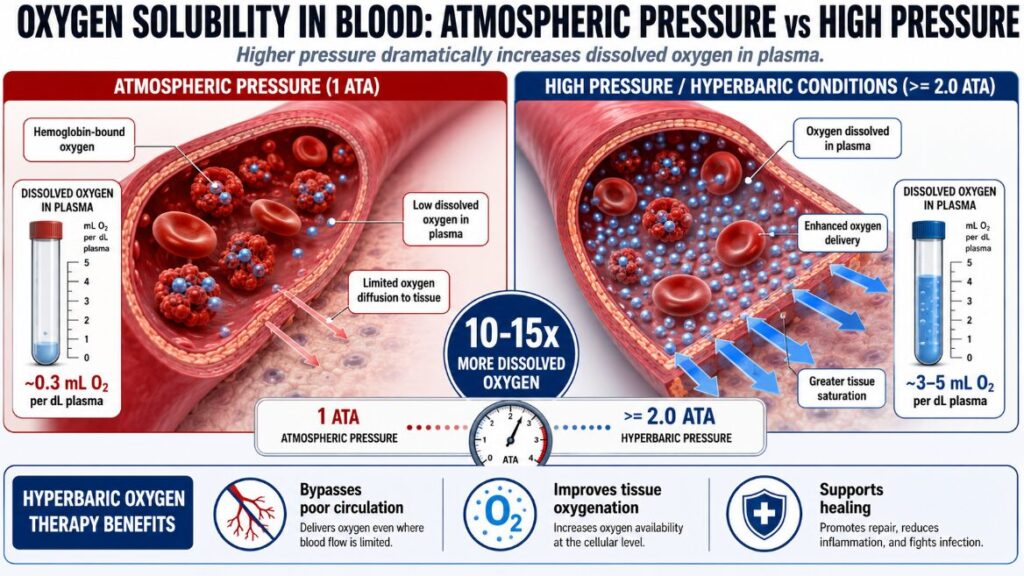
Pour comprendre l'utilité d'une chambre hyperbare, il faut aller au-delà du masque et se pencher sur vos cellules. Nous utilisons le modèle 3A pour expliquer pourquoi ce traitement donne de bons résultats là où la médecine traditionnelle atteint ses limites.
| Paramètres | Oxygène normobare (1,0 ATA) | Oxygène hyperbare (1,5–2,4 ATA) |
|---|---|---|
| Pression atmosphérique | 1,0 ATA | 1,5–2,4 ATA |
| Transport primaire de l'oxygène | Principalement lié à l'hémoglobine | Hémoglobine + forte augmentation de la teneur en oxygène dissous dans le plasma |
| Concentration en oxygène dans le plasma | Augmentation minime | Augmentation significative due à la loi d'Henry |
| Apport d'oxygène aux tissus lésés | Limité par le débit sanguin | Diffusion améliorée dans les tissus peu irrigués |
| Saturation en oxygène du sang (hémoglobine) | Généralement 96–99% | Reste proche de la saturation maximale ; l'effet bénéfique provient de l'oxygène dissous dans le plasma |
| Libération de cellules souches | Niveau physiologique de référence | Une mobilisation accrue a été observée au cours des protocoles thérapeutiques d'OHB |
| Angiogenèse (formation de nouveaux capillaires) | Réponse normale de réparation tissulaire | Stimulation accrue de la formation de nouveaux vaisseaux sanguins au fil des traitements répétés |
| Activité des neutrophiles | Fonction immunitaire normale | Efficacité accrue contre les bactéries anaérobies dans les environnements riches en oxygène |
| Accompagnement dans le traitement des plaies chroniques | Limité | Application clinique courante |
| Effet thérapeutique global | Maintient une oxygénation normale | Améliore l'apport en oxygène, la réparation des tissus et les processus de régénération sous pression thérapeutique |
| Principe 3A | Oxygène normobare | Oxygénothérapie hyperbare |
|---|---|---|
| Absorption | L'oxygène est principalement transporté par les globules rouges | L'oxygène se dissout directement dans le plasma, le liquide céphalo-rachidien et la lymphe |
| Activation | Réponse immunitaire normale | Amélioration de la fonction des neutrophiles et de la capacité à éliminer les bactéries en présence d'oxygène |
| Accélération | Taux de guérison naturel | Augmentation de la mobilisation des cellules souches et stimulation de l'angiogenèse grâce à des séances répétées d'oxygénothérapie hyperbare (OHB) |
Les médecins prescrivent l'oxygénothérapie hyperbare dans le cadre de pathologies spécifiques pour lesquelles l'oxygénation systémique constitue la seule voie vers la guérison.
L'OHB permet d'éviter les amputations en oxygénant le lit de la plaie hypoxique chez les patients diabétiques. Lorsque des taux élevés de glycémie endommagent les petits vaisseaux sanguins, les plaies ne reçoivent plus l'oxygène nécessaire à la synthèse du collagène. L'oxygène à haute pression relance ce processus de cicatrisation “ au point mort ”.
Les chambres hyperbares constituent le seul traitement définitif contre le mal de décompression. La pression réduit physiquement la taille des bulles d'azote présentes dans la circulation sanguine, tandis que le gradient d'oxygène 100% favorise la diffusion de l'azote hors de l'organisme en toute sécurité.
L'OHB élimine le monoxyde de carbone de l'hémoglobine beaucoup plus rapidement que l'air ambiant. Le CO se lie aux globules rouges 200 fois plus fortement que l'oxygène ; la chambre utilise la pression pour “ chasser ” le CO des globules rouges et rétablir le transport de l'oxygène vers le cerveau et le cœur.
Chez les survivants du cancer, l'oxygénothérapie hyperbare (OHB) permet de traiter les effets secondaires à long terme de la radiothérapie. Les rayons peuvent entraîner l'apparition de tissus “ hypovasculaires et hypocellulaires ”. La chambre stimule la formation de nouveaux vaisseaux sanguins dans les zones endommagées par la radiothérapie plusieurs mois, voire plusieurs années auparavant.
Lorsque les infections osseuses résistent même aux antibiotiques les plus puissants, l'oxygénothérapie hyperbare apporte le soutien nécessaire. La plupart des bactéries ostéopathogènes se développent dans des environnements pauvres en oxygène ; l'augmentation du taux d'oxygène rend ces bactéries vulnérables et renforce la capacité de remodelage de l'os.
De nouvelles recommandations cliniques préconisent l'oxygénothérapie par hyperbarie (OHB) comme traitement de première intention en cas de surdité soudaine, à condition qu'elle soit administrée dans les 14 premiers jours. L'oreille interne (cochlée) est extrêmement sensible au manque d'oxygène, et la chambre hyperbare permet souvent de faire disparaître la perte auditive en inondant d'oxygène les structures délicates de l'oreille.
Cette chambre permet d'éliminer rapidement les bulles d'air qui se sont introduites dans le système artériel lors d'une intervention chirurgicale ou à la suite d'un traumatisme. Il s'agit d'une intervention vitale qui permet d'éviter les AVC et les crises cardiaques provoqués par ces obstructions.
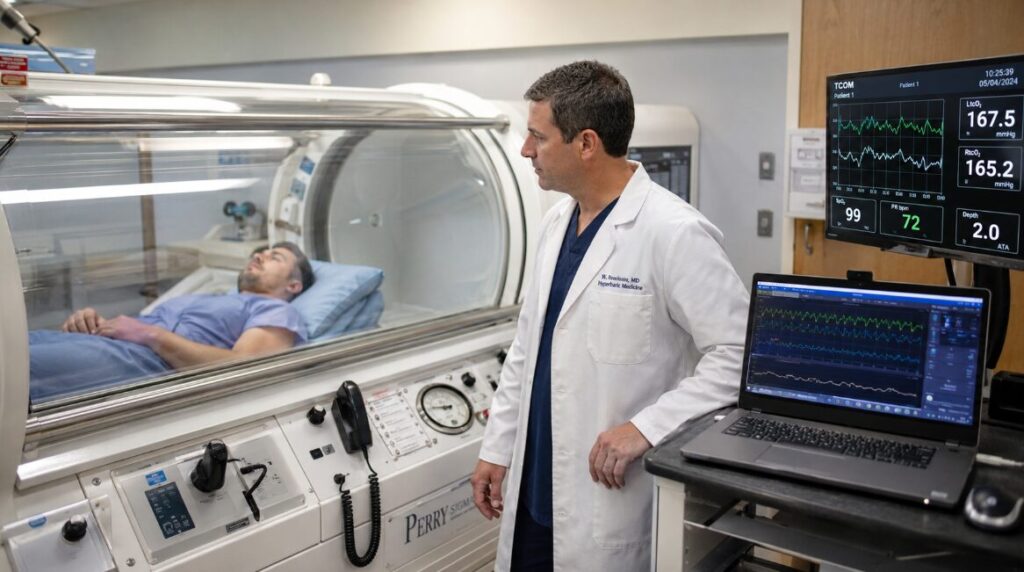
Les patients doivent faire la distinction entre les “ chambres rigides ” cliniques et les “ chambres souples/portables ”. Pour obtenir une véritable guérison médicale des 7 pathologies énumérées ci-dessus, des pressions de 2,0 ATA ou plus sont nécessaires. Les chambres souples, que l'on trouve souvent dans les centres de bien-être ou à usage domestique, atteignent généralement une pression maximale de 1,3 ATA et utilisent de l'air ambiant concentré plutôt que de l'oxygène 100%.
Si vous traitez un ulcère diabétique ou une nécrose radique, l'utilisation d'une chambre souple n'est pas seulement moins efficace : elle entraîne souvent un retard dangereux dans la prise en charge médicale nécessaire. Vérifiez toujours que votre prestataire utilise une chambre à coque rigide certifiée ASME-PVHO.
| Fonctionnalité | Chambre rigide de qualité médicale | Chambre souple destinée au grand public |
|---|---|---|
| Plage de pression typique | 1,5 à 3,0 ATA (les protocoles cliniques utilisent souvent environ 2,0 ATA pour de nombreuses indications) | ~1,2–1,3 ATA (capacité de pression limitée) |
| Structure de la chambre | Système rigide en acier ou en acrylique, conçu selon la norme ASME-PVHO | Enceinte gonflable en tissu souple |
| Méthode d'administration d'oxygène | Livraison habituelle Oxygène de qualité médicale 100% sous pression | Il s'agit généralement d'air ambiant comprimé ; la concentration en oxygène n'atteint souvent pas 100%, sauf en cas d'utilisation d'un système d'appoint. |
| Biodisponibilité de l'oxygène qui en résulte | Forte augmentation de la teneur en oxygène dissous dans le plasma due à une pression élevée | Légère augmentation ; élévation limitée du taux d'oxygène plasmatique |
| Indications cliniques (utilisations autorisées par la FDA aux États-Unis) | Utilisé pour des indications approuvées telles que le mal de décompression, l'intoxication au monoxyde de carbone, certaines plaies qui ne cicatrisent pas, les lésions dues aux rayonnements et d'autres affections médicalement reconnues | N'est pas autorisé pour le traitement des indications médicales de l'oxygénothérapie hyperbare (OHB) approuvées par la FDA ; commercialisé principalement à des fins de bien-être |
| Pathologies concernées (utilisation clinique pratique) | Couramment utilisé dans le traitement des plaies, des lésions ischémiques, des lésions tissulaires dues aux rayonnements et dans le cadre des protocoles d'OHB en milieu hospitalier | Généralement utilisé à des fins de bien-être, d'aide à la récupération, d'adaptation à l'altitude ou de détente |
| Intensité thérapeutique | Haute (oxygénothérapie hyperbare de qualité médicale) | Faible (exposition hyperbare modérée) |
| Effets sur les cellules souches et l'angiogenèse | Observé dans les protocoles cliniques d'OHB à des pressions thérapeutiques (généralement ≥ 1,5 ATA) | Données limitées ou insuffisantes à des pressions plus faibles |
| Prise en charge de l'hypoxie neurologique et tissulaire | Peut améliorer considérablement l'apport en oxygène aux tissus hypoxiques ou mal irrigués, sous surveillance clinique | Impact physiologique minimal par rapport aux systèmes de qualité médicale |
| Certification / Norme technique | Souvent conformes à la norme ASME-PVHO et utilisés dans des environnements médicaux réglementés | Il ne s'agit pas de systèmes médicaux conformes à la norme ASME-PVHO ; ces appareils sont destinés à un usage de bien-être grand public. |
| Exigence en matière de supervision | Surveillance médicale dans les hôpitaux ou dans des centres d'oxygénothérapie hyperbare agréés | Utilisation à des fins personnelles ou suivi de bien-être non médical |
| Systèmes de sécurité | Surveillance avancée, protocoles de décompression d'urgence, contrôles de qualité médicale | Fonctions de base de régulation de la pression et de sécurité, variables selon les fabricants |
| Limitation principale | Coût plus élevé, consultation médicale obligatoire | Les capacités limitées en matière de pression et d'apport en oxygène restreignent les applications cliniques |
| Meilleur cas d'utilisation | Oxygénothérapie hyperbare fondée sur des données scientifiques, sous la supervision d'un médecin | Soutien au bien-être général et utilisation à des fins de rétablissement non clinique |
Votre médecin vous prescrira probablement un programme de “ plongée ” comprenant entre 20 et 40 séances, en fonction de la gravité de votre affection. Chaque séance dure environ 90 à 120 minutes. Vous pourriez ressentir une sensation de “ plénitude ” dans les oreilles, similaire à celle que l'on ressent en avion, mais le processus est non invasif et généralement indolore.
Avant de commencer, assurez-vous que votre clinique utilise la surveillance transcutanée de l'oxygène. Cette technologie mesure avec précision la quantité d'oxygène qui atteint la surface de votre peau lorsque vous êtes à l'intérieur de la chambre, ce qui permet au spécialiste de vérifier l'efficacité du traitement après seulement quelques séances.
Q : À quoi sert principalement une chambre hyperbare ?
R : L'objectif principal est de dissoudre des concentrations élevées d'oxygène dans le plasma sanguin, afin que l'oxygène puisse atteindre les tissus lésés auxquels les globules rouges ne peuvent pas accéder en raison d'un œdème ou d'une mauvaise circulation sanguine.
Q : La chambre hyperbare est-elle utilisée pour la perte de poids ou pour lutter contre le vieillissement ?
R : Bien que les recherches sur l'allongement des télomères et la sénescence cellulaire soient prometteuses, la FDA n'a pas approuvé l'oxygénothérapie hyperbare (OHB) spécifiquement à des fins anti-âge ou de perte de poids. Son utilisation médicale reste axée sur la réparation tissulaire et les cas d'hypoxie.
Q : Combien de séances faut-il généralement effectuer dans une chambre hyperbare ?
R : Pour les affections aiguës telles que l'intoxication au CO, 1 à 3 séances peuvent suffire. Pour les plaies chroniques ou les lésions dues aux rayonnements, le protocole standard prévoit 20 à 40 séances, à raison d'une par jour.
Q : Quels sont les risques liés à l'utilisation d'une chambre hyperbare ?
R : L'effet secondaire le plus fréquent est le barotraumatisme. Parmi les risques rares, on peut citer des troubles visuels temporaires ou une intoxication à l'oxygène ; c'est pourquoi une surveillance clinique dans un établissement agréé est obligatoire.
Q : Puis-je utiliser une chambre hyperbare chez moi ?
R : Seules des chambres “ souples ” à basse pression sont disponibles pour un usage domestique. Celles-ci ne sont pas autorisées par la FDA pour le traitement d’affections médicales graves telles que les plaies ou les infections et ne doivent pas se substituer à l’oxygénothérapie hyperbare en milieu hospitalier.
Série He5000 Macy-Pan : Cambres de 2.0 Ata, Diseño Duradero Y Máximo Roi Par Centros de Salud Y Bienestar Profesional.
Voir les détails
Two Person Hyperbaric Chamber: How To Verify Capacity
Voir les détails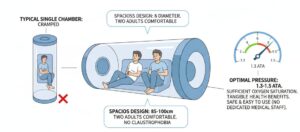
HP1501-100 modelo es de hecho la cámara de oxígeno hiperbárico blanda más eficiente del mercado para el tratamiento de dos personas. Sa taille peut être comprise entre 85 et 100 cm de diamètre et 225 cm de longueur, ce qui fait que deux adultes ne se sentent pas ap...
Voir les détails
HE5000 est une lampe à vapeur à teneur en soufre extrêmement robuste, sûre et confortable. Il s'agit d'une solution très solide pour les clients réguliers, qui doivent préparer des repas à base d'eau hyperbare pour plusieurs clients en même temps, ou pour des clients pri...
Voir les détailsCeci fermera dans 0 secondes