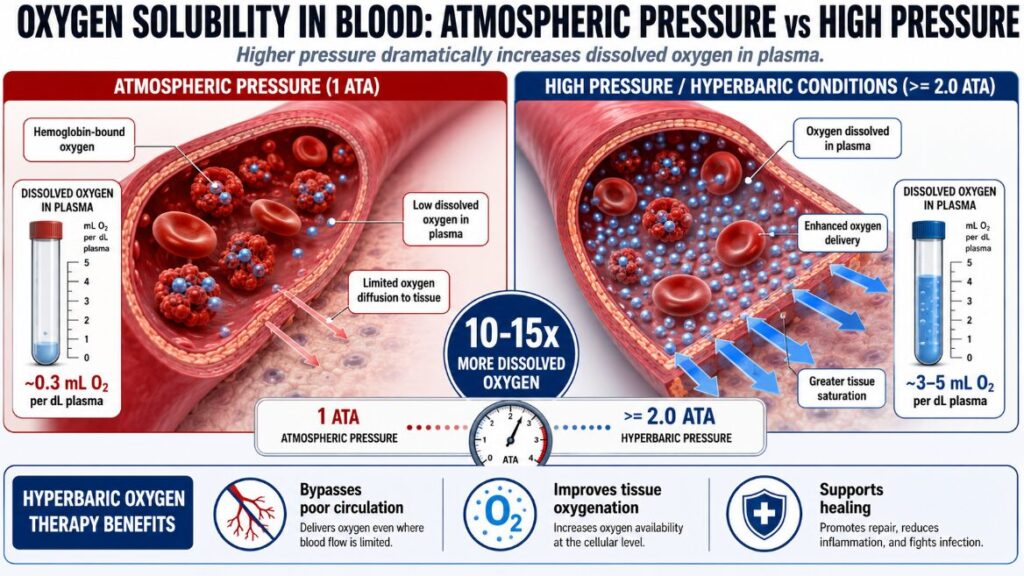
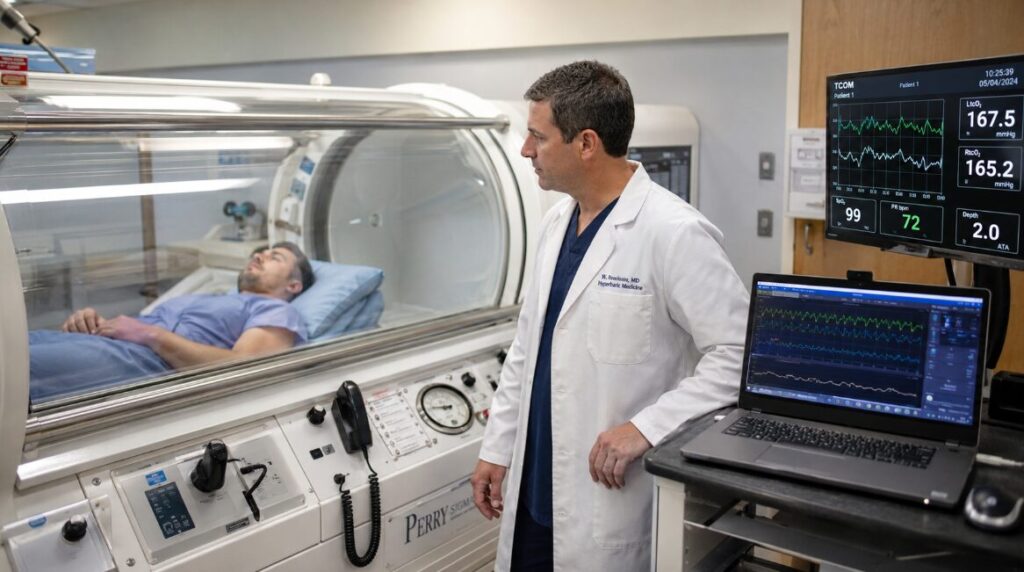
Una cámara hiperbárica es un recipiente a presión médico especializado, diseñado para tratar afecciones en las que los tejidos sufren una falta de oxígeno, mediante el suministro de oxígeno puro 100% a una presión de entre 1,5 y 3,0 veces la presión atmosférica normal. Aunque la mayoría de la gente la asocia con el buceo, su finalidad principal en la medicina moderna es hacer que el oxígeno se disuelva directamente en el plasma sanguíneo, llegando a las zonas dañadas donde la circulación está comprometida. Este proceso desencadena una curación sistémica que va mucho más allá de la simple respiración.
Si estás valorando esta terapia para una herida crónica o una lesión repentina, la distinción entre “respirar oxígeno” y “terapia hiperbárica” es la diferencia entre el mantenimiento y la regeneración.
¿Por qué utilizan los médicos las cámaras hiperbáricas?
Para comprender la finalidad de una cámara hiperbárica hay que ir más allá de la máscara y fijarse en las células. Utilizamos el modelo 3A para explicar por qué este tratamiento da resultados cuando la medicina tradicional llega a un punto de estancamiento.
Absorción: Bajo presión, el oxígeno obedece a la ley de Henry. Deja de depender de los glóbulos rojos y se disuelve en todos los fluidos corporales: el plasma, el líquido cefalorraquídeo y la linfa. De este modo, sortea las arterias obstruidas o estrechadas para llegar al tejido que se está muriendo.
Activación: El oxígeno a alta presión “despierta” a los glóbulos blancos, concretamente a los neutrófilos, lo que los hace mucho más eficaces a la hora de eliminar las bacterias anaeróbicas.
Aceleración: La oxigenoterapia hiperbárica (HBOT) induce al organismo a liberar células madre de la médula ósea y estimula el crecimiento de nuevos capilares. .
Parámetro
Oxígeno normobárico (1,0 ATA)
Oxígeno hiperbárico (1,5–2,4 ATA)
Presión atmosférica
1,0 ATA
1,5–2,4 ATA
Transporte primario de oxígeno
Se une principalmente a la hemoglobina
Hemoglobina + fuerte aumento del oxígeno disuelto en plasma
Concentración de oxígeno en plasma
Aumento mínimo
Aumento significativo debido a la ley de Henry
Suministro de oxígeno a los tejidos afectados
Limitado por el flujo sanguíneo
Mayor difusión en tejidos con escasa irrigación
Saturación de oxígeno en sangre (hemoglobina)
Normalmente, 96–99%
Se mantiene casi al nivel de saturación máxima; el beneficio proviene del oxígeno disuelto en el plasma
Liberación de células madre
Nivel fisiológico basal
Se ha observado una mayor movilización durante los protocolos terapéuticos de oxigenoterapia hiperbárica (HBOT)
Angiogénesis (formación de nuevos capilares)
Respuesta normal de reparación de los tejidos
Mayor estimulación de la formación de nuevos vasos sanguíneos tras tratamientos repetidos
Actividad de los neutrófilos
Función inmunitaria normal
Mayor eficacia frente a las bacterias anaeróbicas en entornos ricos en oxígeno
Apoyo para la curación de heridas crónicas
Limitado
Aplicación clínica habitual
Efecto terapéutico general
Mantiene una oxigenación normal
Mejora el suministro de oxígeno, la reparación de los tejidos y los procesos regenerativos bajo presión terapéutica
Principio 3A
Oxígeno normobárico
Oxígeno hiperbárico
Absorción
El oxígeno es transportado principalmente por los glóbulos rojos
El oxígeno se disuelve directamente en el plasma, el líquido cefalorraquídeo y la linfa
Activación
Respuesta inmunitaria normal
Mejora de la función de los neutrófilos y aumento de la capacidad de eliminar bacterias dependiente del oxígeno
Aceleración
Tasa de curación natural
Aumento de la movilización de células madre y estimulación de la angiogénesis con sesiones repetidas de oxigenoterapia hiperbárica (HBOT)
7 usos médicos fundamentales de las cámaras hiperbáricas
Los médicos prescriben la oxigenoterapia hiperbárica para determinados diagnósticos en los que la oxigenación sistémica es la única vía para la recuperación.
Úlceras del pie diabético y heridas que no cicatrizan
La oxigenoterapia hiperbárica (HBOT) previene las amputaciones al oxigenar el lecho de la herida hipóxico de los pacientes diabéticos. Cuando los niveles elevados de azúcar dañan los vasos sanguíneos pequeños, las heridas no pueden recibir el oxígeno necesario para la síntesis de colágeno. El oxígeno a alta presión reactiva este proceso de cicatrización “estancado”.
Enfermedad por descompresión
Las cámaras hiperbáricas son el único tratamiento definitivo para la enfermedad por descompresión. La presión reduce físicamente el tamaño de las burbujas de nitrógeno presentes en el torrente sanguíneo, mientras que el gradiente de oxígeno 100% favorece que el nitrógeno se difunda fuera del cuerpo de forma segura.
Intoxicación por monóxido de carbono
La oxigenoterapia hiperbárica (HBOT) elimina el monóxido de carbono de la hemoglobina mucho más rápido que el aire normal. El CO se une a las células sanguíneas 200 veces con mayor fuerza que el oxígeno; la cámara utiliza la presión pura para “expulsar” el CO de las células y restablecer el transporte de oxígeno al cerebro y al corazón.
Lesión por radiación tardía
En el caso de los supervivientes de cáncer, la oxigenoterapia hiperbárica (HBOT) trata los efectos secundarios a largo plazo de la radioterapia. La radiación puede provocar la aparición de tejido “hipovascular e hipocelular”. La cámara estimula la formación de nuevos vasos sanguíneos en las zonas dañadas por la radiación meses o años antes.
Osteomielitis crónica refractaria
Cuando las infecciones óseas se resisten incluso a los antibióticos más potentes, el oxígeno hiperbárico proporciona el apoyo necesario. La mayoría de las bacterias que destruyen el hueso prosperan en entornos con bajos niveles de oxígeno; al aumentar los niveles de oxígeno, las bacterias se vuelven vulnerables y se potencia la capacidad del hueso para remodelarse.
Pérdida auditiva neurosensorial súbita
Las nuevas directrices clínicas recomiendan la oxigenoterapia hiperbárica (HBOT) como tratamiento de primera línea para la sordera súbita, siempre que se administre en los primeros 14 días. El oído interno (cóclea) es muy sensible a la falta de oxígeno, y la cámara hiperbárica suele permitir revertir la pérdida al saturar de oxígeno las delicadas estructuras del oído.
Embolia gaseosa arterial
La cámara elimina rápidamente las burbujas de aire que han entrado en el sistema arterial durante una intervención quirúrgica o un traumatismo. Se trata de una intervención que salva vidas y previene los accidentes cerebrovasculares y los infartos provocados por estas obstrucciones.
La trampa de la “cámara blanda”
Los pacientes deben distinguir entre las “cámaras rígidas” clínicas y las “cámaras blandas/portátiles”. Para lograr una curación médica real de las siete afecciones mencionadas anteriormente se requieren presiones de 2,0 ATA o superiores. Las cámaras blandas, que suelen encontrarse en balnearios o para uso doméstico, suelen alcanzar un máximo de 1,3 ATA y utilizan aire ambiente concentrado en lugar de oxígeno 100%.
Si estás tratando una úlcera diabética o una necrosis por radiación, el uso de una cámara blanda no solo es menos eficaz, sino que a menudo supone un retraso peligroso en la atención médica necesaria. Comprueba siempre que tu profesional sanitario utilice una cámara de carcasa rígida certificada por la ASME-PVHO.
Característica
Cámara rígida de grado médico
Cámara blanda para uso doméstico
Rango de presión habitual
1,5–3,0 ATA (los protocolos clínicos suelen utilizar unos 2,0 ATA para muchas indicaciones)
~1,2–1,3 ATA (capacidad de presión limitada)
Estructura de la cámara
Sistema rígido de acero o acrílico diseñado según la norma ASME-PVHO
Recinto inflable de tejido flexible
Método de suministro de oxígeno
Normalmente se entrega Oxígeno de grado médico 100% bajo presión
Normalmente, aire ambiente comprimido; la concentración de oxígeno no suele ser del 100%, a menos que se utilice un sistema de suplementación.
Biodisponibilidad del oxígeno resultante
Fuerte aumento del oxígeno disuelto en plasma debido a la elevada presión
Aumento leve; elevación limitada del oxígeno en plasma
Indicaciones clínicas (usos autorizados por la FDA en EE. UU.)
Se utiliza para indicaciones autorizadas, como la enfermedad por descompresión, la intoxicación por monóxido de carbono, determinadas heridas que no cicatrizan, las lesiones por radiación y otras afecciones reconocidas médicamente.
No está autorizado para el tratamiento de las indicaciones médicas de la oxigenoterapia hiperbárica (HBOT) aprobadas por la FDA; se comercializa principalmente para fines de bienestar.
Afecciones médicas en las que se aplica (uso clínico práctico)
Se utiliza habitualmente en el tratamiento de heridas, lesiones isquémicas, daños tisulares por radiación y protocolos de oxigenoterapia hiperbárica (OHB) en el ámbito hospitalario.
Se utiliza habitualmente con fines de bienestar, apoyo a la recuperación, adaptación a la altitud o relajación.
Intensidad terapéutica
Alta (terapia con oxígeno hiperbárico de grado médico)
Bajo (exposición hiperbárica leve)
Efectos sobre las células madre y la angiogénesis
Observado en protocolos clínicos de oxigenoterapia hiperbárica (HBOT) a presiones terapéuticas (normalmente ≥1,5 ATA)
Evidencia limitada o insuficiente a presiones más bajas
Apoyo en casos de hipoxia neurológica y tisular
Puede mejorar significativamente el aporte de oxígeno a los tejidos hipóxicos o con perfusión deficiente, bajo supervisión clínica
Impacto fisiológico mínimo en comparación con los sistemas de grado médico
Certificación / Norma técnica
A menudo cumplen con la norma ASME-PVHO y se utilizan en entornos médicos regulados
No son sistemas médicos ASME-PVHO; están diseñados para el bienestar de los consumidores.
Requisito de supervisión
Supervisión médica en hospitales o clínicas de oxigenoterapia hiperbárica (HBOT) acreditadas
Supervisión del bienestar para uso personal o con fines no médicos
Sistemas de seguridad
Monitorización avanzada, protocolos de descompresión de emergencia, controles de grado médico
Funciones básicas de control de presión y seguridad; varían según el fabricante
Limitación principal
Mayor coste; se requiere acceso a asistencia médica
La capacidad limitada de suministro de presión y oxígeno restringe las aplicaciones clínicas
Mejor caso de uso
Terapia médica con oxígeno hiperbárico basada en la evidencia, bajo supervisión médica
Apoyo al bienestar general y uso para la recuperación no clínica
Qué significa esto para tu recuperación
Es probable que tu médico te prescriba un programa de “inmersiones” de entre 20 y 40 sesiones, dependiendo de la gravedad de tu afección. Cada sesión dura entre 90 y 120 minutos. Es posible que sientas una sensación de “presión” en los oídos similar a la que se experimenta al volar, pero el proceso no es invasivo y, por lo general, es indoloro.
Antes de empezar, asegúrate de que tu clínica utilice la monitorización transcutánea del oxígeno. Esta tecnología mide con exactitud la cantidad de oxígeno que llega a la superficie de la piel mientras estás dentro de la cámara, lo que permite al especialista comprobar que el tratamiento está surtiendo efecto tras tan solo unas pocas sesiones.
Preguntas frecuentes
P: ¿Cuál es la finalidad principal de una cámara hiperbárica? R: El objetivo principal es disolver altas concentraciones de oxígeno en el plasma sanguíneo, lo que permite que el oxígeno llegue a los tejidos dañados a los que los glóbulos rojos no pueden acceder debido a la inflamación o a una mala circulación.
P: ¿Se utiliza la cámara hiperbárica para adelgazar o para combatir el envejecimiento? R: Aunque las investigaciones sobre el alargamiento de los telómeros y la senescencia celular son prometedoras, la FDA no ha aprobado la oxigenoterapia hiperbárica (HBOT) específicamente para el antienvejecimiento o la pérdida de peso. Su uso médico sigue centrándose en la reparación de tejidos y la hipoxia.
P: ¿Cuántas sesiones se suelen necesitar en una cámara hiperbárica? R: En el caso de afecciones agudas, como la intoxicación por CO, pueden bastar entre 1 y 3 sesiones. Para las heridas crónicas o las lesiones por radiación, el protocolo estándar es de entre 20 y 40 sesiones, administradas una vez al día.
P: ¿Cuáles son los riesgos de utilizar una cámara hiperbárica? R: El efecto secundario más frecuente es el barotrauma. Entre los riesgos poco frecuentes se incluyen alteraciones temporales de la visión o la toxicidad por oxígeno, por lo que es obligatorio que el tratamiento se realice bajo supervisión clínica en un centro acreditado.
P: ¿Puedo utilizar una cámara hiperbárica en casa? R: Para uso doméstico solo están disponibles las cámaras “blandas” de baja presión. Estas no están autorizadas por la FDA para el tratamiento de afecciones médicas graves, como heridas o infecciones, y no deben sustituir a la terapia hiperbárica clínica.
El precio de las cámaras hiperbáricas Macy-Pan varía según el modelo, por ejemplo, el precio de una cámara hiperbárica rígida para 5 personas (HE5000) es de aproximadamente $65.100 (el precio original es de más de $78.000), mientras que el precio de partida de una cámara ...
HP 2202, esta es una cámara de oxígeno suave portátil muy típica. Establece la presión de funcionamiento en 1.3 ATA, que no es un número aleatorio, sino para permitir a los usuarios realizar la oxigenoterapia de manera segura sin que el personal ...
Descubre con qué frecuencia debes utilizar una cámara hiperbárica y cuántas sesiones necesitas realmente para curarte, evitando al mismo tiempo las trampas de las clínicas.
 HBOTSALE