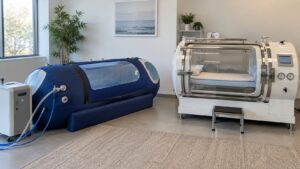
There are only two dead lines in the industry to evaluate the safety pressure of hyperbaric oxygen chambers: the limit of domestic software chambers is 4.4 to 7.3 PSI(1.3 to 1.5 ATA), while the safety range of medical hardware chambers is 14.7 to 29.4 PSI(2.0 to 3.0 ATA). Once the pressure of the software cabin exceeds 7.3 PSI, the polyurethane (TPU) seam will face the risk of tearing. If the medical cabin breaks through the 29.4 PSI, the user will directly face the fatal threat of central nervous system (CNS) oxygen poisoning. Many buyers just glance at these basic data, blindly believe that the device is safe. However, the fact is that unscrupulous manufacturers often exploit loopholes in pressure measurement methods and use “blasting pressure” to secretly replace the concept of “safe working pressure” in order to promote inferior hardware. To avoid the pit, we must dismantle the hard core engineering indicators that really determine the safety of the oxygen chamber.
Surface Numbers vs. Absolute Pressure Trap: Makers Biggest Lies
A favorite trick of hardware vendors is to deliberately confuse gauge pressure (PSIG) and absolute pressure (PSIA). The water is deep: the PSIA contains the base atmospheric pressure at the Earth’s surface (about 14.7 PSI at sea level), while the PSIG simply represents the true “extra pressure” inside the oxygen chamber.
For example, some manufacturers boast that their entry-level equipment can reach “18 PSI”. Hearing this, the buyer thought that he had bought high-power medical-grade equipment. But this is actually 18 PSIA. After subtracting the natural atmospheric pressure of 14.7 PSI, the real pressurization in the cabin is only a poor 3.3 PSIG-this is a mild physical therapy experience at best.
Professional clinical treatment requires extremely accurate PSIG data. A medical grade hardware compartment operating at 2.0 ATA must be provided with substantial 14.7 PSIG extra pressure inside. As a purchaser, you must force the supplier to put the “real worksheet pressure (PSIG)” in the specification in black and white before you pay.
V-P-M Safety Assessment Matrix: Fatal Matching of Pressure and Material
Safety is by no means a cold number on the dashboard. The life of the equipment depends directly on the V-P-M safety matrix: the perfect match of volume (Volume), pressure (Pressure) and material (Material). Imposing high pressure on mismatched inferior materials is equivalent to creating catastrophic mechanical crushing.
Target PSI
Required Material Grade
Safety Limit Threshold
4.4–7.3 PSI
Medical-Grade Thermoplastic Polyurethane (TPU) with Reinforced Hot-Melt-Welded Seams
The physical limit of a soft oxygen chamber is the 7.3 PSI(1.5 ATA). Such devices are typically manufactured using medical grade thermoplastic polyurethane (TPU). The physical strength of the hot melt welding process directly stuck this safety limit. The pressure of the software cabin is controlled at 7.3 PSI, which can dissolve oxygen into plasma and completely avoid the risk of lung oxygen poisoning. Physiotherapy clinics specifically use this pressure interval to relieve altitude sickness or reduce mild inflammation.
Medical Hardware Oxygen Chamber (14.7 – 29.4 PSI)
The hardware cabin can safely withstand the strong pressure of 14.7 to 29.4 PSI(2.0 to 3.0 ATA) through thick steel, aluminum alloy and integrally formed cast acrylic. Medical institutions must rely on this high-pressure environment when dealing with severe cases such as carbon monoxide poisoning, decompression sickness and radiation tissue damage. When the pressure reaches 29.4 PSI, the ambient pressure can force up to 6.8 ml of oxygen into every 100 ml of blood. This physical forced squeezing allows oxygen to penetrate directly into the deepest part of the hypoxic tissue.
Hardware Ultimate Stress Test: Material Fatigue at Peak PSI
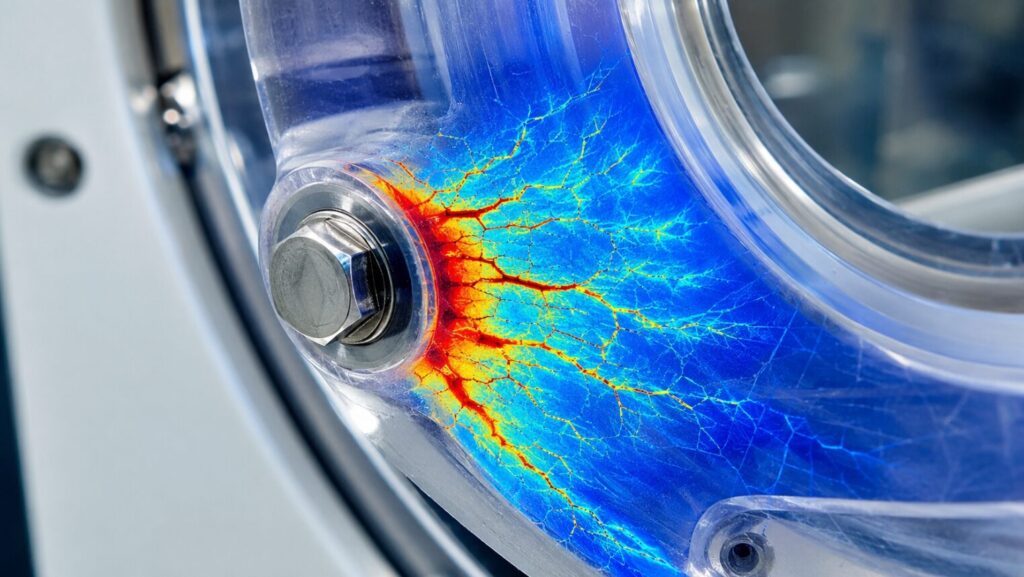
Under long-term extreme pressure, the interior of the acrylic cabin will undergo structural degradation that cannot be detected by the naked eye. The 1 independent structural engineering report for 2025 provides an in-depth analysis of medical acrylic flanges operating at 25 PSI. The test data revealed a brutal dead line: 10,000 cycles of pressurization. After 10,000 times of pressurization and decompression at 25 PSI, cast acrylic showed a large number of microcracks on the fixed edge of the metal bolt. This means that equipment buyers must focus on the “number of cycles”, rather than simply looking at the “factory year” of the equipment “. If a clinic runs at full capacity 6 times a day at peak pressure, the fatigue limit of the material will be reached in less than 5 years. Once this red line is crossed, the risk of explosive pressure relief will increase exponentially.
Two-stage pressure relief valve: 2026 hard core standard for pressure control
The safety of modern hyperbaric oxygen chambers depends entirely on mechanical failure redundancy design. At present, the benchmark of the whole industry is the two-stage continuous pressure regulating valve (CPMV). Old oxygen tanks usually only have a spring valve. In case that spring gets stuck due to moisture and rust, the pressure in the cabin will instantly lose control and directly break through the structural limit. However, the latest two-stage CPMV system has a “double insurance”: the first 1 is a purely mechanical pressure relief valve accurately set at the maximum PSIG; The second channel is an electronic sensor. Once the pressure exceeds the standard by 0.5 PSI, the power supply of the oxygen compressor will be cut off instantly. In this day and age, any equipment not equipped with this two-stage redundancy system-whether medical or household-was only meant to be thrown directly into the recycling bin.
Häufig gestellte Fragen (FAQ)
Q: How much PSI is the 2.0 ATA in the hyperbaric chamber? 2.0 ATA is equivalent to an additional pressure of 14.7 PSI (I. e. PSIG) in the cabin, or the absolute pressure reaches 29.4 PSI(PSIA). This level of pressure requires the use of a hard capsule, which is also a hard threshold for standard clinical treatment.
Q: Can a soft hyperbaric oxygen chamber withstand 10 PSI? Absolutely not. The soft oxygen chamber uses TPU material and hot melt seam process, and its design safety limit is 7.3 PSI(1.5 ATA). If the soft compartment is pushed hard to 10 PSI, structural bursting will definitely occur at the seams or zippers.
Q: What is the maximum safe PSI threshold for oxygen toxicity? The absolute upper safety limit specified in clinical guidelines is 29.4 PSIG(3.0 ATA). If you breathe 100 percent pure oxygen for a long time in an environment that exceeds this pressure, it will cause the risk of central nervous system (CNS) oxygen toxicity, which can lead to severe convulsions and even shock.
Q: Why is the PSI displayed on the dashboard of my oxygen chamber different from the instructions? Your instrument panel usually shows PSIG (internal added pure pressure), while the manual is usually marked PSIA (absolute pressure including external atmospheric pressure). The PSIG readings on the dashboard must be closely watched when developing any treatment plan.
Q: How does the pressure relief valve prevent the explosion of the oxygen chamber? The pressure relief valve is essentially a precision-calibrated mechanical spring that automatically pops when the internal PSI exceeds a certain set point. If the rated pressure of an oxygen chamber is 4.4 PSI, once the pressure reaches 4.5 PSI, the valve spring will open instantly to discharge excess gas, thus preserving the structural integrity of the chamber.
Q: How often does the PSI safety valve of the hyperbaric oxygen chamber need to be tested? The equipment engineer requires that mechanical pressure relief valves be fully tested every 6 months. Salts, ambient moisture and dust from human sweat can easily stiffen the release mechanism, which directly changes the precise PSI threshold at which the valve should be activated.
For those who are planning to buy a hyperbaric oxygen chamber, the first point of contention is: should we buy a soft chamber like “a large sleeping bag” or a hard chamber like “a submarine”? Don't look at them all as oxygen chambers. In fact, fr...
Das Modell HP 2202 ist mehr als nur ein Gerät. Es ist ein Sauerstoffspeicher mit Hardware 2.0 ATA (oder auch höher), der für die gewerbliche Nutzung mit hoher Frequenz entwickelt wurde. Seine ursprüngliche Absicht ist sehr direkt: die Maximierung der Investitionsrendite (ROI) des Unternehmens...
Wenn es um die tatsächlichen Kosten einer hyperbaren Sauerstoffkammer geht, müssen wir zunächst ein Konzept verstehen: "Total Landing Cost". Die endgültigen Kosten für die Software tragbare Modell (wie die bekannten ST801 oder ST901) ist in der Regel zwischen U...
Das HP2202 2 ATA ist ein individuelles Sauerstoffsammelgefäß aus Hartschaum, das die wichtigsten Punkte der Industrie mit Präzision erfüllt. ¿Puede realmente alcanzar la presión clínica 2.0 ATA sin participar en la instalación de ingeniería extrema...
 HBOTSALE