 HBOTSALE


高圧酸素チャンバーには、安全にどれくらい滞在できるのでしょうか?
609高圧酸素チャンバーには、安全にどれくらい滞在できるのでしょうか?120分という制限時間と、一晩中眠ることがなぜ致命的になるのかについて解説します。.
詳細を見る駅全体を検索
The principle of hyperbaric oxygen chamber is to put you into a completely sealed chamber, filled with medical grade pure oxygen, and then pull up the air pressure in the chamber to between 1.3 and 3.0 ATA (absolute atmospheric pressure). In this high-pressure environment, pure oxygen will directly bypass the red blood cells and be forced into your plasma, cerebrospinal fluid and deep tissues.
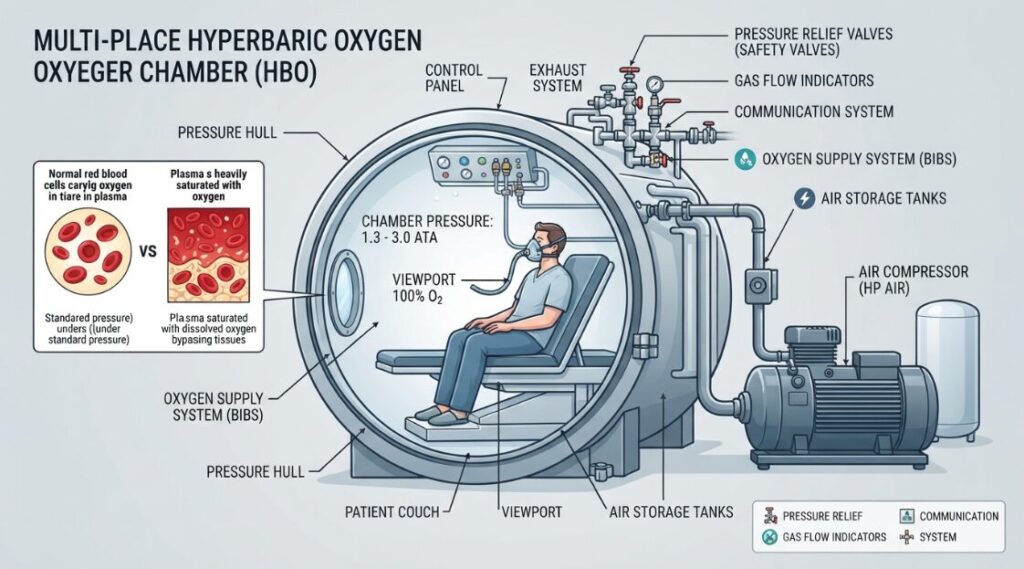
At ordinary times, when searching for pictures of hyperbaric oxygen chambers on the Internet, buyers usually can only see a person lying in a tube with his eyes closed-to be honest, this is the same as not looking. After analyzing the clinical-grade HBOT (hyperbaric oxygen therapy) system for ten years, I watched countless consumers spend tens of thousands of dollars in vain because they could not understand the internal mechanical drawings. Today, let’s take a hard-core dismantling to see how these machines work, 1 pick up all kinds of valves inside, and then expose the hidden rules of “pressure critical point” that equipment sales never mention.
To understand any complex mechanical diagram of a hyperbaric oxygen chamber, you need a clear framework in your mind. When I usually train clinic bosses, I like to use the “P.A.D. oxygen funnel” model. Every part on the drawing, the work done cannot run out of these 3 stages:
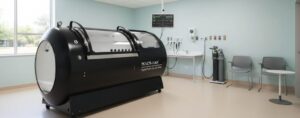
Don’t just stare at the acrylic shell, a truly clinical-level system can be divided into three core areas from the mechanical structure.
The material of the cabin directly determines how much high-intensity treatment you can do. The hard cabin uses hard-core steel plates or ultra-thick acrylic walls, which can withstand terrorist pressures up to 3.0 ATA. What about the soft compartment? It uses basically TPU (thermoplastic polyurethane) material and locks the air inside against a heavy-duty explosion-proof zipper. The pressure relief valve is usually installed in the cabin head. After the operator sets the target value, once the air pressure in the cabin reaches the standard, the valve will automatically exhaust out to maintain a safe balance.
The real drudgery is actually the peripheral equipment. The air compressor is responsible for sucking the air in the room, filtering out dust and impurities, and then pressing it into the cabin to establish an air pressure environment. The oxygen generator is another independent pipeline, which is responsible for stripping out the nitrogen in the air and producing 90-96% pure oxygen. Now some new machines in 2026 even add a biofeedback loop system. Smart sensors can adjust the air supply of the compressor in real time according to the blood oxygen saturation in your body.
If you buy a hard cabin, the BIBS mask is absolutely not a life-saving component. The cabin is filled with pressurized ordinary air, and you need to suck that 100 percent pure oxygen through this tightly fitting mask. Why is it so troublesome? Because if you fill the pressurized cabin with pure oxygen directly, the whole cabin will become a high-energy bomb. Moreover, the mask has a closed-loop exhaust function, and the carbon dioxide you exhale will be directly discharged outside the cabin without polluting the cabin environment.
Understand the operation mechanism of hyperbaric oxygen chamber, in fact, in a word: Pressure can change the physiology.
In the Plain Everyday Environment (1.0 ATA), our bodies basically rely on red blood cells to transport oxygen. You can think of the red blood cells as a bus. Once the seats are full, the remaining oxygen cannot get on. The high-pressure environment bypasses the bus system directly. When the pressure is pulled to the 2.0 ATA or even higher, the machine will abruptly “plug” free oxygen molecules into the plasma (the liquid that surrounds the blood cells). This oxygen-rich plasma can then pass through clogged blood vessels, into swollen brain tissue, or to damaged muscle fibers where blood simply cannot flow through.
Don’t forget to check the specific ATA values on the parameter table before paying for the machine or signing the contract. The “1.3 ATA Soft Cabin Trap” kills thousands of suckers who don’t do their homework every year.
Those so-called “mild hyperbaric oxygen therapy (mHBOT)” soft plastic cabins are limited by the material, and the legal air pressure limit is stuck in 1.3 ATA. Sales will blow this thing into a “miracle” to cure all diseases “. But the cruel truth is: 1.3 ATA has a very limited increase in plasma oxygen content-it is really good to relieve fatigue or mountain illness, but if it is for serious clinical treatment, the pressure is simply scratching the surface. To really promote angiogenesis (that is, to grow new capillaries), you have to go to a hard cabin with an air pressure of at least 2.0 ATA. If you’re looking to buy a soft cabin to heal serious wounds, its structural strength simply won’t do it.
In our in-house laboratory evaluation, I recorded a direct relationship between the air pressure in the cabin and the actual absorption by the body. After reading the following set of data, you will understand why there must be high-voltage mechanical parts.
| Pressure Level (ATA) | O₂ Delivery Method | PaO₂ Level (mmHg) |
|---|---|---|
| 1.0 ATA | Normal breathing (ambient air, 21% O₂) | ~100 mmHg |
| 1.5 ATA | Soft hyperbaric chamber with nasal cannula | ~400 mmHg |
| 2.4 ATA | Hard hyperbaric chamber with BIBS mask (100% O₂) | 1,500–1,800 mmHg |
A full 15-fold increase in oxygen content under 2.4 ATA is the hard indicator that really triggers large-scale cell repair.
People Also Ask (FAQs)
What does the drawing of the hard cabin and the soft cabin look different?
The hard cabin drawings are all extremely strong steel or acrylic shells with BIBS mask exclusive pipelines that can hit 2.0 to 3.0 ATA. The soft cabin drawing is usually a TPU bag with zipper, equipped with an ordinary compressor, and the air pressure cap is 1.3 ATA.
How did the oxygen get into the hyperbaric chamber?
Go is a double pipe system. 1 tube is responsible for pumping pressurized ambient air into the large cabin; the other 1 a medical-grade line that delivers pure oxygen directly to your BIBS mask or nasal cannula.
Can you see inside the hyperbaric chamber from the outside?
Sure. Hard cabins generally have huge acrylic transparent windows, and some simply have a transparent cylinder as a whole. The soft cabin usually also leaves a small observation window made of reinforced plastic.
Does the machine make a lot of noise?
The cabin is basically maintained at between 50 and 60 decibels (just like the hum of your refrigerator when it is running). The main movement actually comes from the outside air compressor and the hissing sound when the pressure relief valve regulates the air.
What exactly does the “2.0 ATA” marked on the drawing mean?
ATA is the abbreviation of absolute atmospheric pressure. 2.0 ATA means that the air pressure in the capsule is twice as high as when you stand at sea level. Only at this level of physical pressure can oxygen be efficiently pressed into your plasma.
高圧酸素チャンバーには、安全にどれくらい滞在できるのでしょうか?120分という制限時間と、一晩中眠ることがなぜ致命的になるのかについて解説します。.
詳細を見る
Master Hyperbaric Chamber Use For Faster Healing. Explore Target Protocols For Athletes, Surgery And Anti-Aging.
詳細を見る
で終了する。 0 おかわり