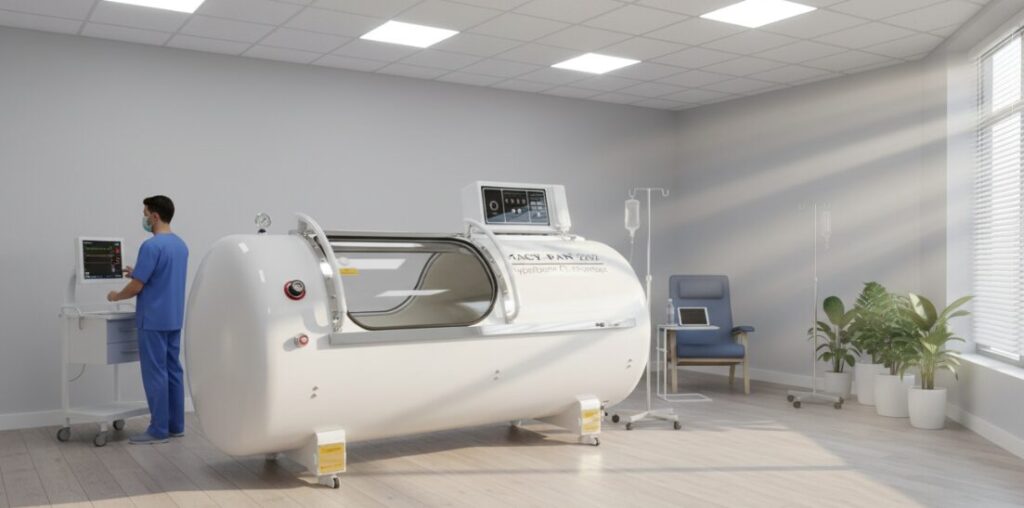
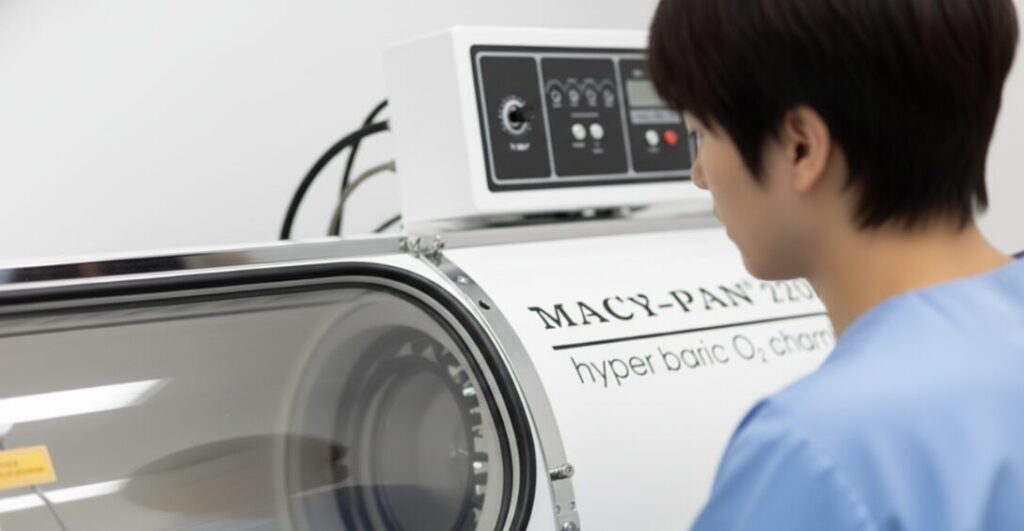
Decompression out of the cabin typically takes 10 to 15 minutes. This time window is not just a casual remark; it depends largely on your specific plan for this “dive” and the pressure level you achieve.
In clinical practice, if it is a standard 2.0 ATA treatment regimen, I usually strictly require 15 minutes of slow decompression to allow enough time for the nitrogen in the body to be physically “off-target” discharged; and if it is a low-pressure household light cabin, The decompression process is often completed in 5 to 10 minutes. This slow-paced decompression process is designed to prevent decompression sickness and ensure your ears are comfortable adjusting as environmental pressure returns to sea level. We will use safety valves or automated systems to maintain this pressure relief rate, essentially to prevent your eardrum from being harmed by sudden changes in pressure.
Clarify The Relationship Between ATA Pressure Value And Decompression Time
Clinical Medical Environment: Clinics use higher levels of stress when dealing with conditions such as long-standing wounds or carbon monoxide poisoning. On the way back from 2.0 ATA to 1.0 ATA, 15 minutes of decompression is the industry’s “gold standard”. In my experience, this duration allows the body’s tissues to adapt perfectly to the physical changes caused by doubling the volume of the internal air spaces.
Lightweight/Home Environment: This portable soft pod operates at much lower pressures. Because the pressure difference between the treatment pressure and the external pressure is small, the rise rate can be slightly faster, usually ending in 5 to 10 minutes, and the safety is completely fine.
The Science Behind Nitrogen Desaturation
This 10-15 minute window period was really not something you could come up with by patting your head; it was all based on physiology. During hyperbaric oxygen therapy, your body’s tissues absorb much more oxygen and nitrogen than usual.
To be honest, if decompression is instantaneous, the gases dissolved in the body ——especially nitrogen—— will burst into bubbles in the blood like soda with a pull tab just pulled open. This is called decompression sickness. By maintaining this controlled, gradual process, we’re actually directing these gases through the bloodstream to the lungs slowly and then exhaling naturally, rather than letting them swell across your joints or tissues.
To the forefront of nutrition
HE5000
2.0ATA, Medical grade pressure is suitable to home health, Dimensions: 82 x 65 x 72 inch for 1-3 person using.
Ear Pressure Balance And Tympanic Membrane Protection
The most direct and realistic reason for maintaining a constant pressure relief rate is to protect the patient’s tympanic membrane. When the pressure in the cabin drops, the air in your middle ear expands due to heat.
Preventing barotrauma: If the decompression is too strong, the pressure difference between the inside and outside will quickly widen. At mild, it will sting the ears, and at worst, it will be a barotrauma.
Controlling the rate of rise: This robust 10 to 15 minutes “rise period” gives the patient enough time to do ear pressure balancing. Whether it’s swallowing, yawning or the Valsalva maneuver we taught you, this time difference ensures that the pressure in your middle ear can keep up with the rhythm of the descent in the cabin, so that you won’t feel that heart-wrenching pain when you exit the cabin.
Technical Accuracy: Safety Valve And Automation System
Current engineering technology has minimized “human error” in the decompression process. To ensure that treatment plans can be accurate to the second, our current operations are basically supported by professional equipment:
Safety valves: These valves are calibrated at the factory and limit the maximum amount of exhaust per unit time, so that even if the operator’s hands shake, there will be no unexpected rapid pressure reduction.
Automation system: Most single-person cabins and multi-person cabins now run computer control programs. The system will focus on the pressure curve and ensure a constant rate whether it is a linear or logarithmic decrease, which is crucial for patient comfort in clinical practice.
As operators, we are working hard on this 10-15 minute agreement so that when you return to the real world from that high-pressure repair environment, you can be as smooth and silky as when you enter.
Author: Robert Miller
Having supervised more than 20,000 successful decompression cycles, my primary mission is to bridge the gap between complex hyperbaric physics and patient safety. I specialize in developing rigorous ascent protocols that prioritize eardrum protection and nitrogen off-gassing efficiency. My goal is to ensure that every patient’s transition from the chamber back to ambient pressure is as safe, comfortable, and scientifically sound as the treatment itself.
TheHP1501-85 1.5ATA single thin hyperbaric oxygen chamber does not compromise with living space while maintaining medical-grade efficacy. Unlike bulky commercial cabins that require a dedicated room to fit, this model has a very compact footprint...
 HBOTSALE