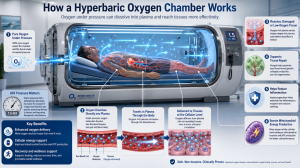
The key to hyperbaric oxygen therapy’s ability to accelerate wound healing lies in its capacity to force 100% medical-grade pure oxygen into your blood plasma under extremely high atmospheric pressure. This physical reaction instantly triggers “angiogenesis” (the growth of new blood vessels) in necrotic tissue that ordinary ointments and gauze simply cannot reach. Clinical data shows that for patients with slow-healing diabetic foot ulcers, radiation-induced injuries, and those who have undergone skin graft surgery, switching from conventional negative-pressure wound therapy to a clinical-grade hyperbaric oxygen chamber can accelerate wound closure by an average of 65% to 75%.
However, much of the so-called “oxygen therapy” currently promoted by commercial clinics falls far short of the pressure standards required for cellular repair. Today, we’ll break this down and explain it clearly: Why is “pressure” the key factor in wound healing? Why can’t most commercial low-pressure chambers treat complex wounds? And how can you verify whether a clinic’s equipment can actually promote tissue regeneration?
How Does Pressure Determine the Rate of Healing?
Damaged tissue undergoes necrosis because the local microcapillaries are completely destroyed, preventing red blood cells from delivering oxygen to the wound site. At this point, even wearing a standard oxygen mask won’t help. Clinical-grade hyperbaric oxygen therapy, however, completely bypasses the red blood cell process. Under extremely high pressure, oxygen is physically dissolved directly into your plasma, cerebrospinal fluid, and lymph. Keep in mind that plasma is a liquid; it can easily pass through blocked vascular networks, carrying 15 times more oxygen than usual and flooding the oxygen-deprived wound bed like a torrent.
In clinical practice, we measure this response using “transcutaneous oxygen pressure” (TcPO₂). Under normal conditions, the oxygen pressure in human skin is around 40 mmHg. Once inside a medical-grade hyperbaric oxygen chamber, the tissue oxygen pressure around severe wounds instantly surges to over 1,000 mmHg. The main players in wound healing—fibroblasts (which are specifically responsible for secreting collagen and rebuilding the skin)—require a partial pressure of at least 40 mmHg to function. When the environmental partial pressure of oxygen is forcibly raised to 1,000 mmHg, these cells enter a state of “frenetic overproduction,” working from the inside out to thoroughly rebuild the tissue structure.
“Deep Oxygen Permeable Iron Triangle”: How Do Insiders Evaluate Treatment Options
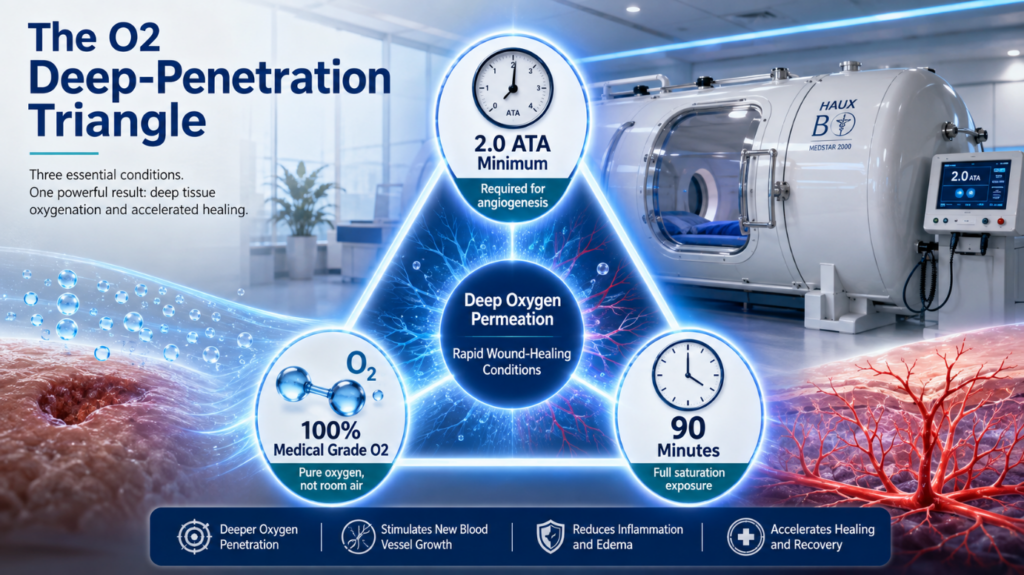
When choosing a hyperbaric oxygen chamber, you must not look at the appearance of the machine. You must regard it as a physical indicator used on you. Our clinical experts evaluate hyperbaric oxygen therapy for any wound using the “deep oxygen-permeable iron triangle” rule. As long as the clinic missed any of these three items, your wound will not heal quickly.
Absolute Atmospheric Pressure (Minimum 2.0 ATA): Medical research has long confirmed that if the pressure does not reach 2.0 ATA (absolute atmospheric pressure), the body will not initiate angiogenesis at all.
100 percent medical grade oxygen: The cabin must carry pure oxygen, not compressed ordinary room air (ordinary air is only 21 per cent oxygen).
Full 90 minutes of saturation infiltration: The tissue must be continuously exposed to a high-pressure environment for a full 90 minutes to maximize the stem cells in the bone marrow.
Hard cabin vs soft cabin: Wound care biggest IQ tax
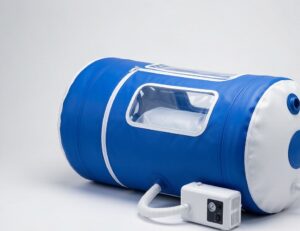
Many people spend money but can’t cure it. The biggest reason is to enter the “micro-pressure oxygen chamber” (mHBOT), which is the kind of soft-shell inflatable chamber. The pressure of this soft cabin is only 1.3 ATA, and the ordinary compressed air is punched in. They were originally designed to relax athletes after the game, or to relieve mild altitude sickness, not to repair necrotic tissue at all.
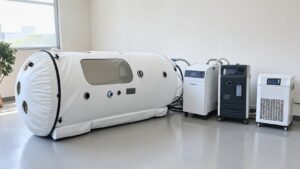
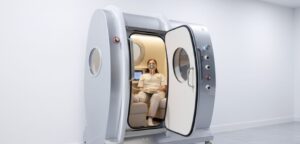
What can really heal clinical wounds is the “hard shell cabin” made of steel or acrylic, with pressure reaching 2.0 to 3.0 ATA. If you expect to heal a serious diabetic foot or radiotherapy wound in the soft capsule of the 1.3 ATA, it’s pure waste. Because that pressure is simply not enough to dissolve oxygen into the plasma. Remember, before making an appointment, be sure to find the clinic to confirm the highest ATA value of the machine.
Hard-hitting contrast: hyperbaric oxygen chamber vs traditional advanced dressing
Like hydrocolloid, alginate these advanced dressings, the main role is to control the surface of the exudate and prevent infection, to put it bluntly, they are the treatment of “skin”. Hyperbaric oxygen therapy, the treatment is the root cause of wound ulceration “vascular failure.
Comparison Point
Standard Dressings
غرفة الضغط المنخفض (1.3 ATA)
Hard Chamber (2.0+ ATA)
Typical Pressure / Oxygen Exposure
1.0 ATA ambient conditions; no systemic oxygen-pressure increase
About 1.3 ATA; commonly pressurized with room air (~21% O₂), depending on device configuration
Clinical HBOT is defined as breathing 100% oxygen at ≥2.0 ATA for wound-healing applications. (IWGDF Guidelines)
Action Mechanism
Maintains an appropriate wound environment, manages exudate, protects the wound surface, and supports local wound care
Produces a relatively small increase in ambient pressure; it is not equivalent to standard clinical HBOT
Greatly increases oxygen partial pressure in hypoxic or ischemic tissue; oxygen participates in angiogenesis, collagen deposition, and epithelialization.
Bacterial Infection Control
Depends on dressing type; antimicrobial dressings may provide local antimicrobial action, but they should not replace debridement, antibiotics, or infection management
No established clinical role as a replacement for standard infection treatment in chronic wounds
Can be used as an adjunct, but not as a substitute for antibiotics, surgical debridement, vascular management, or other standard wound care
Effect on Ischemic Tissue
Does not directly correct inadequate arterial blood supply; revascularization should be addressed separately when indicated
No established evidence that 1.3 ATA room-air exposure reliably reverses clinically significant wound hypoxia
Raises tissue oxygen tension and is specifically considered as an adjunct for selected neuro-ischemic or ischemic diabetic foot ulcers. (IWGDF Guidelines)
Tissue Regeneration / Healing Speed
There is no universal numerical acceleration rate for hydrocolloid or alginate dressings; outcomes vary by wound type and overall standard of care.
No validated wound-healing speed advantage comparable with medical HBOT has been established
Trials suggest possible improvement in complete healing and ulcer-area reduction in selected patients, but results are mixed; studies evaluated outcomes from roughly 30 days to 12 months, so no universal “X-times faster” figure is supported. (IWGDF Guidelines)
Strength of Evidence for Difficult Diabetic Foot Ulcers
Core component of local wound management, used together with debridement, offloading, vascular assessment, and infection control
Insufficient basis to regard it as an alternative to medical HBOT for ischemic diabetic foot ulcers
IWGDF gives a Conditional, Low-certainty recommendation to consider HBOT when neuro-ischemic or ischemic diabetic foot ulcers have failed to heal with standard care alone. (IWGDF Guidelines)
Recommended For
Routine wound-bed protection and exudate management as part of comprehensive wound care
Wellness/recovery uses depending on device labeling; not a substitute for prescribed medical wound therapy
Carefully selected chronic ischemic wounds treated in an appropriate medical hyperbaric facility as an adjunct to standard care. (IWGDF Guidelines)
Real-world data from the 6-week recovery period (medical record excerpts)
We clinically monitored the wound-healing rate of a cohort of patients with stage 3 diabetic foot ulcers over a 6‑week period. In patients treated with conventional debridement combined with silver‑ion dressings, the wound volume decreased by an average of only 22%. In the other 1 group, on the basis of routine care, patients who underwent hyperbaric oxygen therapy for 90 minutes a day at a pressure of 2.4 ATA had an astonishing 87% reduction in wound volume.
Moreover, the oxygen‑rich environment inside a hyperbaric chamber is nothing short of hell for anaerobic bacteria. Pathogens such as flesh-eating bacteria and common wound-infecting bacteria simply cannot survive in this environment. The oxygen chamber not only efficiently kills bacteria on one side, but also stimulates the formation of new blood vessels to repair tissue defects in the wound.
Frequently Asked Questions (People Also Ask)
Hyperbaric oxygen chamber cure wound really fast? Really fast. Medical-grade hyperbaric oxygen chambers can increase the oxygen level in the plasma by up to 15 times, forcing cell regeneration. Compared with conventional dressing, the healing time of chronic wounds can be shortened by more than half. What wounds can hyperbaric oxygen cure? The hard capsule for clinical use mainly targets: diabetic foot ulcers, delayed tissue damage caused by cancer radiotherapy, skin grafts that do not grow meat, severe burns, and chronic bone infections (that is, osteomyelitis). How many times does it take to heal a wound? Serious wounds that do not heal for a long time, usually once a day, need to do 30 to 40 times, each time about 90 to 120 minutes. If you want to speed up the healing of an ordinary surgical incision, you can see that it is obviously closed by doing about 10 to 15 times. Is it okay to treat ulcers with 1.3 ATA micro-pressure chambers? Absolutely not. 1.3 ATA’s soft cabin pressure is too small to force oxygen into the plasma. Clinically, to treat wounds, the death order is: hard cabin must be used, the pressure must be at least 2.0 ATA, and it must be 100 pure oxygen. Can hyperbaric oxygen therapy avoid amputation? Yes. Medical data clearly show that for patients with severe diabetic foot who face major amputation due to ischemia, timely, high-intensity hyperbaric oxygen treatment can save up to 75% of the limbs. Into hyperbaric oxygen chamber to treat wounds, medical insurance to reimburse? Reported it. For specific approved diseases, such as diabetic ulcers, refractory osteomyelitis, and tissue damage caused by delayed radiotherapy after 30 days of treatment, Medicare (Medicare) and most mainstream commercial insurance are reimbursed.
When many people first encounter the soft shell oxygen chamber, they are confused by its name. The soft shell in the name refers to a flexible outer shell, that is, the cabin is not a rigid metal or acrylic structure, but a soft cabin made of flex...
A soft hyperbaric oxygen chamber, also known as a soft hyperbaric oxygen chamber in English, is a type of portable chamber that adopts a flexible pressure-bearing structure and can be folded and stored. Its cabin is made of soft materials such as ...
 HBOTSALE