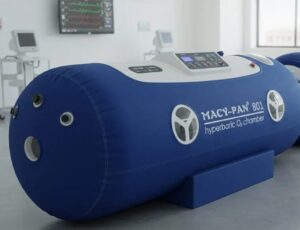
Medical-grade hardware hyperbaric oxygen chambers typically operate at pressures between 2.0 and 3.0 ATA (absolute atmospheric pressure), which is equivalent to 14.7 to 29.4 psi above normal atmospheric pressure. However, the upper pressure limit of common commercial software cabins on the market is much lower, generally between 1.3 and 1.5 ATA (that is, 4.4 to 7.3 psi higher than the ambient pressure). If you choose the wrong pressure parameters, your physical therapy plan will basically be ruined. If your physical condition requires 2.4 ATA pressure, but you buy a low-pressure software cabin cheaply, it is absolutely ineffective. However, if the pressure is too strong and too fast, it is easy to cause serious middle ear barotrauma. In this article, we have clarified all the pressure parameters, safety critical points, and technical conversions of those twists and turns. It is no problem to evaluate any equipment with this guide.
Hardware vs software: what do you think about the pressure rating?
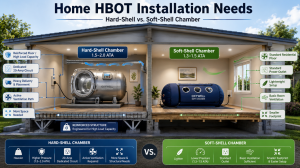
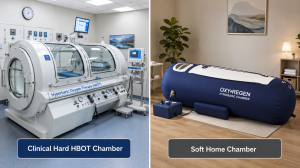
When engineers define the pressure of a hyperbaric oxygen chamber, one standard is “absolute atmospheric pressure” (ATA). One ATA, to put it bluntly, is the standard atmospheric pressure we feel at sea level. How much internal pressure an oxygen chamber can safely withstand depends entirely on its structural strength-whether it is made of flexible polyurethane or hard steel and acrylic.
ATA Level
Equivalent Sea Water Depth (FSW)
Added Gauge Pressure (PSIG)
Chamber Type
Primary Use Case
1.3 ATA
9.9 FSW
4.4 PSIG
Soft-Shell
Low-pressure wellness and recovery sessions
1,5 ATA
16.5 FSW
7.4 PSIG
Soft-Shell / Hard-Shell
Mild hyperbaric applications and supervised wellness use
2.0 ATA
33.0 FSW
14.7 PSIG
Hard-Shell
Standard clinical hyperbaric oxygen therapy
2.4 ATA
46.2 FSW
20.6 PSIG
Hard-Shell
Clinical wound care and radiation-injury protocols
3.0 ATA
66.0 FSW
29.4 PSIG
Hard-Shell
Emergency and specialized hyperbaric treatment protocols
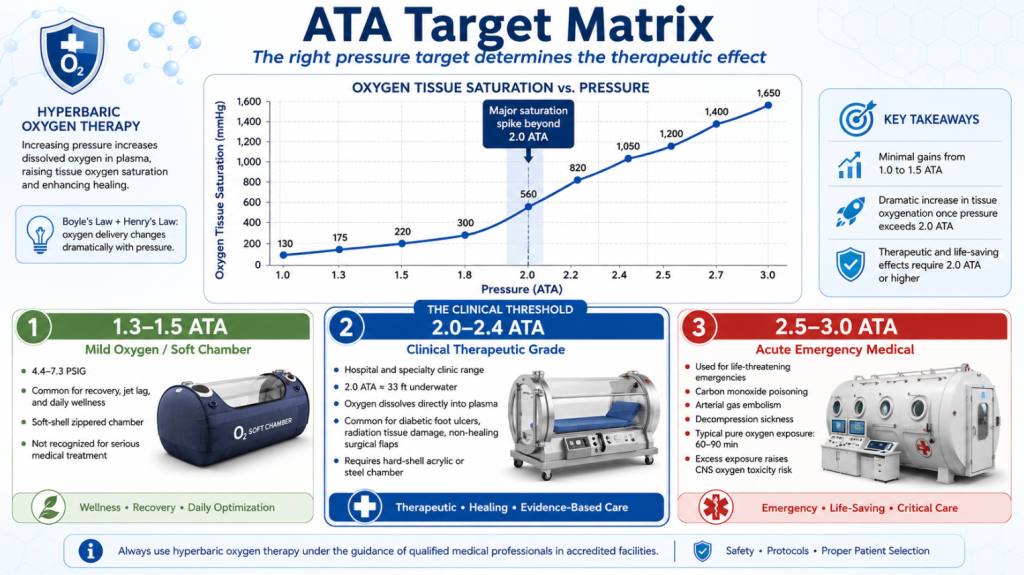
“ATA target matrix”: the right remedy can be effective
You can’t cure all diseases with the same pressure setting. According to the physics of Boyle’s Law and Henry’s Law, the way oxygen dissolves into plasma at a certain depth is different. For ease of understanding, we have divided the target pressure into 3 levels.
1.3 to 1.5 ATA (Mild Oxygen/Soft Cabin)
The zippered software compartment basically stays in this low pressure area, which will only add 4.4 to 7.3 psi of pressure to the compartment. Athletes and biohackers like to use this pressure, mainly for basic muscle recovery, jet lag and daily health care. But be aware that the FDA (U.S. Food and Drug Administration) does not recognize 1.3 ATA can be used to treat any serious medical conditions. 1.3 ATA does make the oxygen saturation in the tissue a little higher than usual, but wants to force oxygen into the necrotic bone tissue? There is no way.
2.0 to 2.4 ATA (clinical therapeutic grade)
Hospitals and specialty clinics generally use 2.0 to 2.4 ATA to treat a variety of chronic diseases approved by the FDA. At 2.0 ATA (equivalent to diving 33 feet underwater), oxygen will be directly and mechanically dissolved into plasma, completely bypassing the “porter” of red blood cells “. If it is to treat diabetic foot ulcers, radioactive tissue damage or surgical flaps that have not healed, the clinic will usually directly hit the pressure to the 2.4 ATA. To achieve this level of therapy, you have to get a hard-body single cabin made of acrylic or steel.
2.5 to 3.0 ATA (Acute Emergency Medical)
Large hospital cabins that can hold multiple people can reach up to 3.0 ATA(29.4 PSIG), which is used to save lives. Doctors use this extreme pressure only when dealing with acute carbon monoxide poisoning, severe arterial gas embolism and decompression sickness (diving man’s disease). There is a strict time limit (usually 60 to 90 minutes) to inhale 100 percent pure oxygen at 3.0 ATA. If the time limit is exceeded, patients will face a great risk of central nervous system (CNS) oxygen toxicity.
Businessmen’s Flicker: ATA and PSI Digital Games
Those manufacturers who sell low-end cabins like to use their hands and feet on pressure data, making buyers who are doing their homework dizzy.
How do they cheat people? It is to use the conceptual difference between “absolute pressure (ATA)” and “gauge pressure (PSIG). We all know that 1 ATA equals 14.7 psi. Some dishonest merchants will mark their software cabins as “14.7 PSI high-powered high-pressure cabins!” The gimmick, sounds like a bull’s-a-bull, doesn’t it? But in fact, this number only represents the normal gravity pressure of the earth-this broken cabin doesn’t add any extra pressure at all! Therefore, when buying, be sure to ask what the “gauge pressure (PSIG)” is. A genuine 1.3 ATA cabin with a gauge pressure of about 4.4 PSIG. And a medical cabin 2.0 ATA, the gauge pressure is 14.7 PSIG. If the specific ATA value is not confirmed, don’t rush to pay.
Anti-pit guide: How to pressurize to protect your ears?
For people who do hyperbaric oxygen for the first time, middle ear barotrauma is definitely the biggest safety hazard. It should be noted that this injury only occurs during the “pressurization” (I. e. pressure rise) phase, because the increase in pressure in the cabin exceeds the speed at which the patient’s Eustachian tube adjusts its balance, and not because it is caused by staying at the highest pressure for too long.
Linear Pressurization vs Ladder Pressurization
Clinical data have clearly indicated how to pressurize. If the patient is “pushed” to the 2.0 ATA within 3 minutes, nearly 18% of the people will feel ear pain. Qualified oxygen chamber operators will use a slow, controlled pressurization rate of about 1.0 to 1.5 psi per minute. It takes at least 10 to 12 minutes to reach the depth of treatment of 2.0 ATA. If the patient feels that the ear is stuffy or painful, the operator will immediately stop the pressure-this is called the “step pressure method”-to allow the patient time to swallow, yawn or do Valsalva movements (pinch the nose and shut up the exhalation method), and then continue after the ear adapts.
Foire aux questions (Questions fréquentes)
How much pressure does hyperbaric oxygen chamber need to treat wound healing? For complex wound healing such as diabetic ulcers or delayed radiation injury, healthcare professionals may rigorously use pressures 2.0 to 2.4 ATA(14.7 to 20.5 PSIG). The kind of soft capsule that runs in the 1.3 ATA cannot reach the plasma oxygen saturation required for deep tissue regeneration.
How deep is 2.0 ATA equivalent to underwater? The internal pressure of the 2.0 ATA is exactly the same as the physical pressure felt by a scuba diver in 33 feet (10 meters) of water. If it is 3.0 ATA, that is equivalent to 66 feet (20 meters) underwater.
Does the pressure in the hyperbaric chamber damage your ears? I will. If the cabin pressure is too fast, it will cause middle ear barotrauma, resulting in ear pain, water accumulation and even eardrum perforation. Professionally trained technicians will extend the boost time to 10 to 15 minutes to avoid this risk, allowing enough time for the patient to balance the ear pressure.
What is the maximum pressure of a soft hyperbaric oxygen chamber? The limit of the zippered software compartment is 1.5 ATA. Those flexible nylon, canvas and polyurethane materials cannot withstand more than 7.3 PSIG pressure in terms of physical properties. If they are hard, they will definitely burst catastrophically.
Why are some cabins marked PSI and some ATA? ATA (absolute atmospheric pressure) is the standard unit for measuring total pressure in medicine. PSI (pounds per square inch), on the other hand, usually refers to the “gauge pressure” produced by the air compressor “. Remember that 1.0 ATA is always equal to standard sea level barometric pressure (I. e. absolute pressure 14.7 PSI, or gauge pressure 0 PSI).
Can a person feel the pressure in the cabin? You will only feel the change in physical pressure in the ears and sinuses during the initial pressurization (equivalent to diving) and the final decompression (floating). Once the cabin reaches the target pressure and stabilizes, your body will not feel any pressure or squeezing.
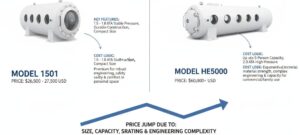
En ce qui concerne le système de prix des caissons d'oxygène hyperbare Macy-Pan, l'éventail est en effet très large. En bref, une petite cabine à coque dure pour une personne coûte généralement entre 26 000 et 27 500 dollars américains. Par contre, si vous avez besoin d'une grande cabine 2.0 ATA...
Découvrez ce qu'est une chambre à oxygène sous pression et comment elle vous aide à guérir. Découvrez ses véritables bienfaits et les arnaques à éviter.
 HBOTSALE