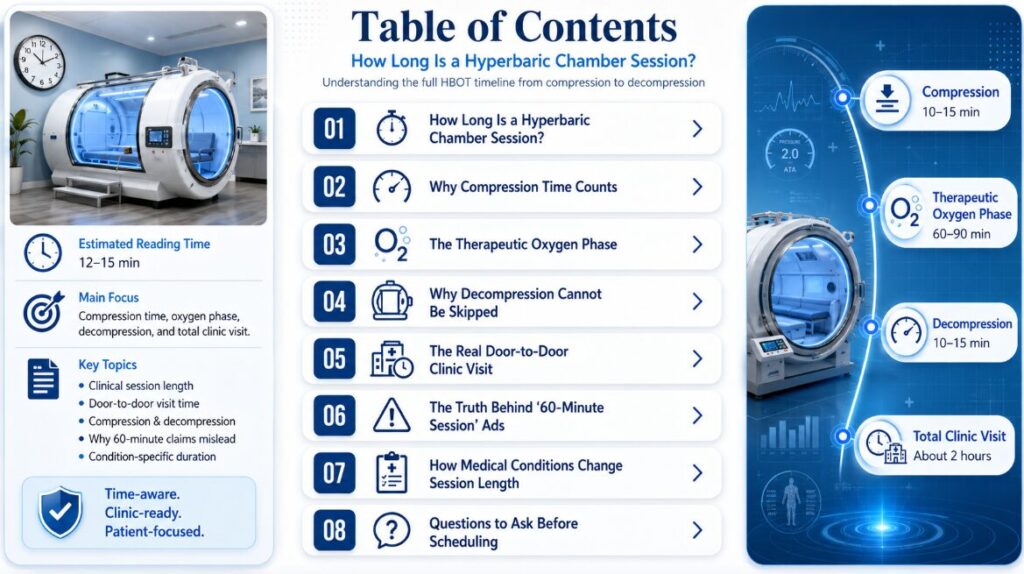
A standard clinical hyperbaric chamber session lasts exactly 90 to 120 minutes of continuous in-chamber time, dictating a total clinic visit of roughly two hours. When new patients ask how long is a hyperbaric chamber session, they expect a simple flat number like a massage appointment. The medical reality involves strict physics: your body requires dedicated time to adjust to atmospheric pressure changes before the actual oxygen therapy even begins. Clinics frequently advertise a “60-minute session” by only quoting the middle therapeutic phase, deliberately hiding the mandatory compression and decompression times. This deceptive scheduling leaves busy professionals missing afternoon meetings and family members waiting blindly in the lobby. We will dissect the exact minute-by-minute biological timeline of your dive, expose the “door-to-door” time trap, and break down how specific medical conditions drastically alter your required duration.
The T.B.T. Framework: Deconstructing Your Actual Appointment
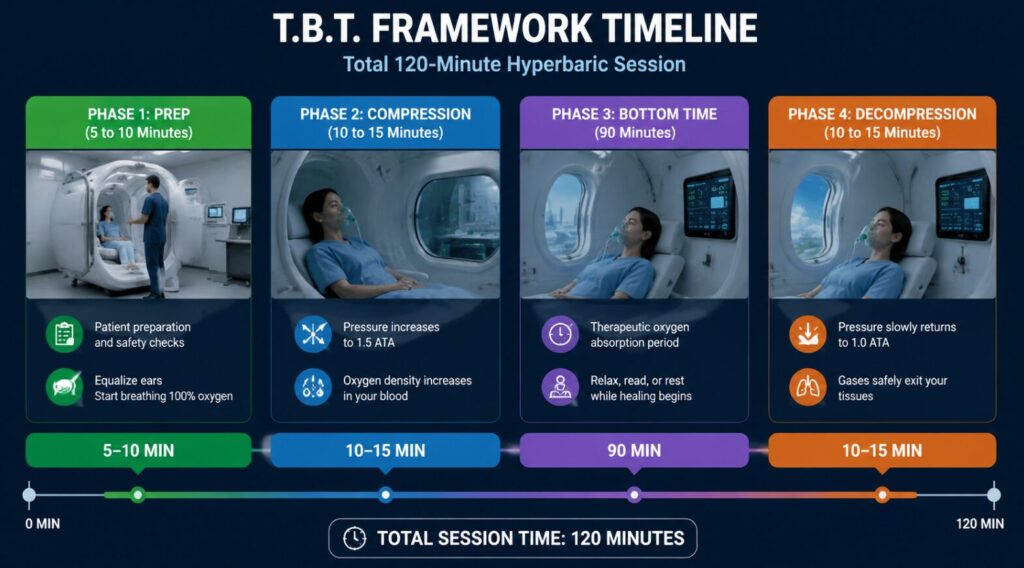
Calculating your true time commitment requires the T.B.T. (Total Block Time) Framework. Every single session in a medical-grade monoplace or multiplace chamber consists of four non-negotiable physical phases.
Phase 1: Vitals and Prep (10 to 15 Minutes)
Nurses must measure your baseline vitals and conduct a strict contraband check before you enter the acrylic tube. You will change into 100% cotton scrubs to eliminate static electricity risks. Medical staff will check your tympanic membranes (eardrums) and verify your blood pressure and blood glucose levels, as high-pressure oxygen directly impacts metabolic burn rates.
Phase 2: The Compression Descent (10 to 15 Minutes)
Pressurizing the chamber to the target 2.0 or 2.4 ATA (Atmospheres Absolute) takes biological time to prevent middle-ear barotrauma. The technician slowly pumps 100% pure oxygen into the chamber, listening to your feedback as you clear your ears via the Valsalva maneuver. Rushing this phase ruptures eardrums, so the exact minute count depends entirely on your personal sinus anatomy and equalization speed.
Phase 3: The Therapeutic Bottom Time (60 to 90 Minutes)
This is the active healing phase where you simply lie still and breathe. Once the chamber reaches the prescribed ATA, the pressure stabilizes. During this period, your blood plasma hyper-saturates with oxygen, clearing Wallerian degeneration debris and triggering angiogenesis (new blood vessel growth). When people ask hyperbaric chamber how long is a session, they are usually thinking only of this specific block.
Phase 4: The Decompression Ascent (10 to 15 Minutes)
Returning to normal sea-level pressure (1.0 ATA) forces dissolved gases out of your tissues. Depressurizing too rapidly mimics scuba diving injuries like decompression sickness (the bends). The exhaust valves slowly release the pressurized oxygen, gradually returning the internal environment to room pressure so you can safely exit.
Disease-Specific Protocols: Matching Time to Trauma
The nature of your injury dictates the exact length of your therapeutic bottom time. Breathing pure oxygen under pressure is a drug dosage, and clinicians adjust the minute count based on cellular hypoxia levels.
Chronic Wounds and Radiation Tissue Damage (90-Minute Bottom Time)
Patients recovering from late radiation tissue injury or diabetic foot ulcers require a massive sustained cellular energy spike. Protocols for these conditions universally demand a 90-minute bottom time at 2.0 to 2.4 ATA. Factoring in the descent and ascent, caregivers should expect the patient to remain inside the chamber for a minimum of 115 minutes per daily visit.
Emergency toxicological treatments break the standard time rules. Carbon monoxide violently binds to hemoglobin, and flushing it out requires prolonged exposure to 3.0 ATA. These emergency sessions easily stretch from 120 to 150 minutes of continuous bottom time.
Sports Recovery and Biohacking (60-Minute Bottom Time)
Athletes utilizing HBOT for post-surgical recovery or lactic acid clearance generally run shorter profiles. A 60-minute bottom time at a milder 1.5 to 2.0 ATA is standard. Those asking how long are hyperbaric chamber sessions for general wellness will find their total in-chamber time hovers around 80 minutes.
Condition
Target ATA
Bottom Time
Total T.B.T. Door-to-Door Time
Chronic Wounds & Late Radiation Tissue Damage
2.0–2.4 ATA
90 minutes
Minimum 115 minutes
Acute Carbon Monoxide Poisoning
3,0 ATA
120–150 minutes
140–170+ minutes
Sports Recovery & Biohacking
1,5 à 2,0 ATA
60 minutes
Around 80 minutes
The 2026 Shift: AI-Assisted Decompression Scheduling
Recent advancements in pneumatic chamber technology are shrinking the non-therapeutic transition times. Up until recently, technicians manually controlled the pressurization valves, often pausing the descent entirely if a patient struggled to clear their ears, wildly throwing off clinic schedules.
Clinical data published in early 2026 showcases new monoplace chambers equipped with dynamic AI-assisted compression algorithms. These systems monitor real-time middle-ear pressure resistance and automatically micro-adjust the flow rate. This technology eliminates sudden pressure spikes, allowing a smoother continuous descent that shaves exactly 4 to 6 minutes off the compression phase without increasing patient discomfort. Clinics adopting this hardware offer much tighter scheduling accuracy for busy outpatients.
The Insider Pitfall: The “60-Minute” Booking Trap
Booking a 1:00 PM meeting after a 11:00 AM session is the most common scheduling disaster new patients face. Facilities answering the question how long is hyperbaric chamber treatment over the phone frequently quote “one hour.” They mean the prescription dose is one hour.
You must account for the clinic’s operational friction. If your appointment is at 11:00 AM, you will not reach target pressure until 11:25 AM due to changing, vitals checks, and the descent. A 60-minute dose pushes you to 12:25 PM. The 10-minute decompression brings you to 12:35 PM. Getting dressed and signing out means you walk out the front door at 12:45 PM. Always block out a full two hours on your calendar for any standard HBOT appointment to avoid professional scheduling crises.
Questions fréquentes (FAQ)
Can I get out of the hyperbaric chamber early? Yes, but it is not instantaneous. If you experience severe claustrophobia or an ear pain emergency, the technician will trigger a rapid decompression. However, even an emergency exhaust takes 2 to 3 minutes to safely normalize the pressure to prevent lung barotrauma.
How many times a week should you do a hyperbaric chamber? Clinical protocols for physical nerve damage, radiation injury, or wound healing require strict daily consistency. Patients typically attend sessions 5 days a week (Monday through Friday) for a total of 20 to 40 sessions. Scattered, infrequent visits fail to sustain the angiogenesis (new blood vessel growth) required for permanent tissue repair.
Do you sleep during a hyperbaric chamber session? Yes, most patients fall asleep during the therapeutic bottom time. Once the chamber reaches target pressure and the popping sensation in your ears stops, the environment is highly oxygenated, cool, and quiet, naturally promoting deep rest. The technician will wake you via the intercom before initiating the decompression phase.
Can I bring my phone into a 90-minute HBOT session? No. Mobile phones, tablets, and wireless earbuds contain lithium-ion batteries. Taking them into a 100% oxygen-enriched environment under pressure creates a severe flash-fire risk. Clinics provide exterior mounted televisions with pneumatic headsets for entertainment during your 90-minute session.
How long does it take to see results from hyperbaric oxygen therapy? Structural biological changes do not happen after one session. You will notice localized swelling reduction and improved energy within the first 5 to 10 sessions. Measurable wound healing, tissue regeneration, and neurological improvements typically require 20 to 30 cumulative hours of hyperbaric exposure.
Why does my hyperbaric session take longer on the first day? Your initial visit includes an extensive medical orientation. The attending physician will review your exact dive profile, teach you specific ear-clearing techniques (like the Valsalva maneuver), and conduct a test pressurization to gauge your sinus tolerance. Expect your Day 1 appointment to take up to 2.5 hours.
À l'heure actuelle, le prix de détail d'une cabine haut de gamme à coque dure pour plusieurs personnes, telle que la HE5000, est généralement d'environ $59 900 USD auprès d'un revendeur agréé offrant un service complet. La cabine d'entrée de gamme à coque souple commence à près de $8 000 USD. En fait, il peut...
Il n'existe pas de terme unique en anglais pour désigner une chambre à oxygène hyperbare souple. Les termes utilisés varient selon les personnes et les pages produits. Le terme le plus courant pour désigner un équipement qui est également une cabine souple, pouvant être pliée et rangée, est « soft hyper... ».
Guide d'expert sur les précautions de sécurité en chambre hyperbare. Apprenez à gérer les risques d'incendie, la sécurité des oreilles et les protocoles cliniques.
 HBOTSALE