When you see a device marked as a 2.0 hyperbaric chamber, don’t rush to directly understand “2.0” as stronger, more suitable, or already suitable for a certain type of medical use. This notation itself lacks two crucial pieces of information: the unit of measurement, and whether the value represents normal operating pressure, treatment pressure, or the equipment’s upper limit. Procurement decisions should begin with the pressure rating, not with the numerical value.
First, Replace 2.0 With The Same Pressure Rating
ATA stands for absolute atmospheric pressure, with zero defined as a vacuum. 1 ATA represents absolute pressure at one standard atmosphere, not an additional atmosphere above ambient pressure. At this 1 caliber, 2.0 ATA is equal to 202.6 5千帕 absolute pressure, which is about 29.3918 psia.
At standard sea level atmospheric pressure, the 2.0 ATA corresponds to a gauge pressure of about 101.32 5千帕, or 14.6959 psig. Actual environmental pressure varies with altitude and weather conditions; when converting absolute pressure to gauge pressure on-site, the local ambient pressure should be used. If the supplier only writes “2 atm” or “29 psi”, he should continue to ask whether it is absolute pressure or gauge pressure. The two calibers are mixed together, the numbers seem to be close, but the meaning may be completely different.
A Single ATA Number Cannot Replace A Complete Pressure Specification
The technical data shall at least separate the normal working pressure, the maximum allowable working pressure and the set pressure of the pressure relief device. The rated pressure or maximum pressure is not equal to the pressure in a specific use plan, and it cannot be inferred from an upper limit value for all operating conditions.
During verification, you can compare the quotation, the model specification sheet, the equipment nameplate, and the operation manual side by side. Verify that they correspond to the same complete model and configuration, and then check that the pressure units match the reference zero. If a document only states “2.0” without specifying ATA, psia, or psig, and does not indicate the pressure unit, the specification still lacks comparability.
Reaching 2.0 ATA Does Not Automatically Satisfy Clinical Criteria
The current UHMS clinical hyperbaric oxygen definition involves not only the lowest 2.0 ATA, but also conditions such as the whole body being in a hardware cabin that meets the corresponding pressure vessel and fire protection regulations and breathing medical grade oxygen. The ability of a device to achieve 2.0 ATA cannot be individually demonstrated that it meets this definition, nor can it be demonstrated that a particular model has been licensed for a particular market or is suitable for a particular disease.
When used in a medical setting, the specific equipment should continue to be checked against its intended use, target market approvals, pressure vessel and fire protection requirements, oxygen supply protocols, and professional supervision conditions. Pressure values are only one of the criteria; they do not serve as a substitute for evidence of efficacy, safety, or compliance.
Even With The Same 2.0 ATA Standard, The Architecture And Usage Methods May Still Differ
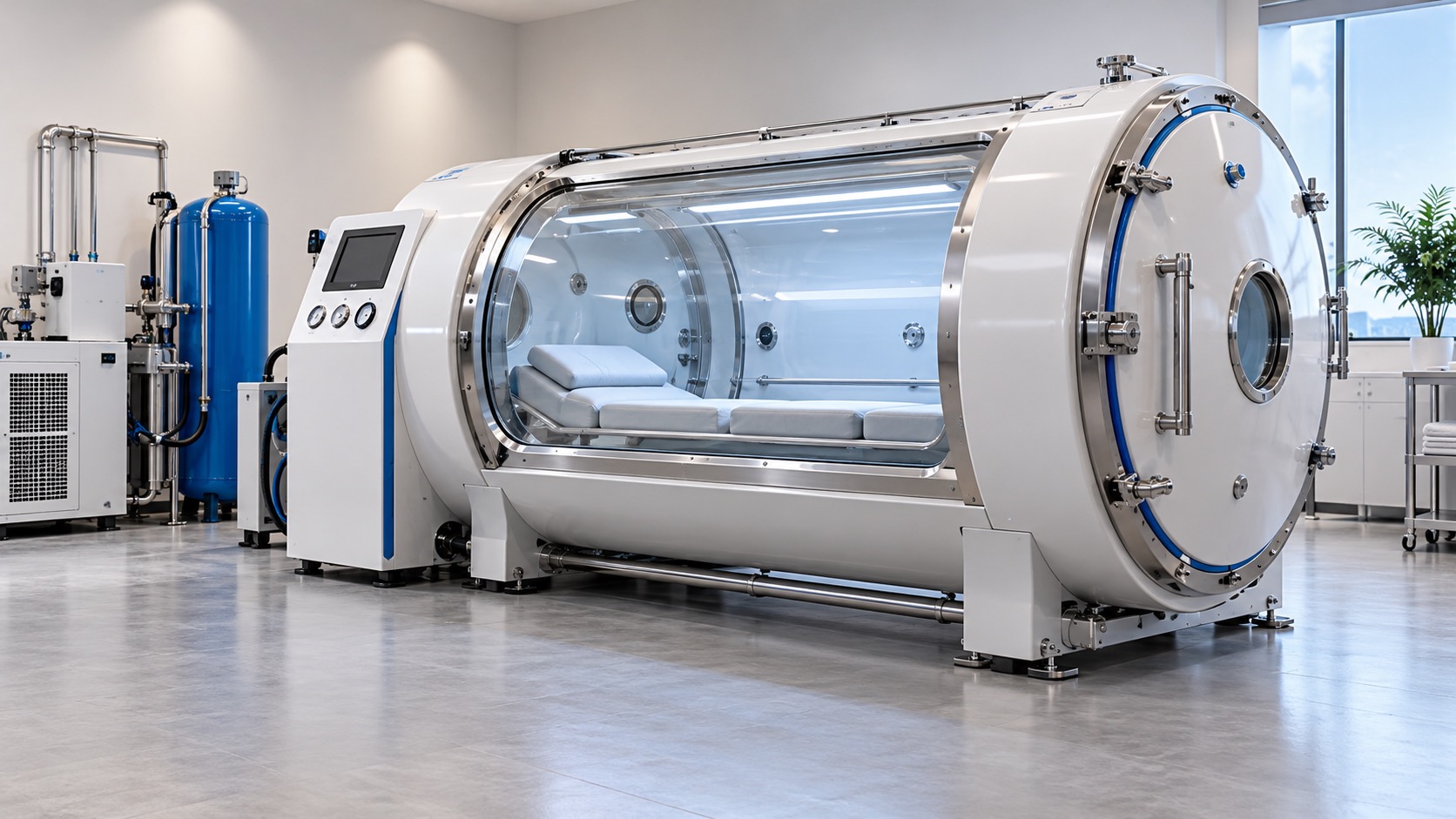
2.0 ATA products can adopt different architectures. In the existing product data, HP2202 belongs to horizontal hardware cabin, providing 75cm, 85cm and 90cm in diameter. HP2202 DIA is also a horizontal hardware cabin with enlarged transparent windows, providing 90cm and 100cm in diameter. Both are 220cm in length, but the catalog does not establish a one-to-one correspondence between each diameter and each weight value. When inquiring, separate specification tables for sub-models or each diameter version shall be required.
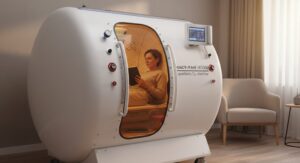
In addition, there are HP750 with single sitting, HE5000 Mono with walk-in transparent doors, and HE5000 Fort, HE5000 and HE5000 Plus for multi-person layout. Although they all have 2.0 ATA pressure specifications, the entry mode, posture, number of people, external dimensions and system configuration are different. It is usually more effective to confirm how the user enters, what posture he adopts, whether he needs multiple people to use it at the same time, and then talk about the model.
Verify The Cabin And The Entire System Together
A hyperbaric chamber system is more than just the chamber itself. The air compressor supplies filtered air and maintains cabin pressure, while the automatic valves ensure pressure stability; the oxygen-generation unit is responsible for providing oxygen-enriched gas. Different 2.0 ATA models also have different matching methods: HP2202 data lists all-in-one machines and air conditioners, HP2202 DIA lists all-in-one machines and high-efficiency air cooling systems; In the HE5000 series, different models use different combinations of all-in-one machines, oxygen generators, air compressors and cooling systems.
Therefore, whether the quotation specifies “chamber” or “system” is crucial. The inclusion of control, compression, oxygen supply or oxygen production, cooling, communication and safety accessories should be confirmed item by item to avoid direct comparison between the price of the cabin only and the quotation including complete supporting equipment.
Include The Venue And Acceptance Criteria In The Checklist Before Making The Purchase
Dimension verification should not be based solely on the length or diameter of the cabin. Transportation corridors, door widths, turning space, floor load capacity, power supply, ventilation, fire protection, grounding, and maintenance clearances all affect whether equipment can be installed. Horizontal, seated, walk-in, and multi-person configurations shall also be inspected for net entrance dimensions, thresholds, internal usable space, rated capacity, and emergency evacuation conditions, respectively.
Upon arrival, the manufacturer, brand, full model number, submodel, serial number, or unique device identifier shall match the contract and packing documents. Pressure, pressure relief, ventilation, air or oxygen supply, control, alarm, communication and emergency functions shall be verified in accordance with the manufacturer’s procedures and accepted standards for the model. If missing documents, configuration discrepancies, alarms, leaks or structural damage are found, they should be recorded and restricted for use, rather than judging from the appearance that the equipment is available.
Finally, tighten the RFQ question to one sentence: Can the supplier use the same model 1 set of documents to explain the unit and pressure attributes of the 2.0, and at the same time prove the structure, complete system, site requirements, intended use and acceptance method? This is closer to a truly executable procurement judgment than comparing an ATA number alone.
Descubra los beneficios de la cámara HBOT para infecciones virales: Elimine la Niebla Cerebral, Aumente la Energía y Movilice las Células Madre para una Reparación Profunda.
Descubre cómo dormir en una cámara hiperbárica mejora el sueño profundo y la recuperación. Guía de expertos sobre cómo elegir entre unidades duras o blandas y sobre seguridad.
Descubra los beneficios respaldados por la ciencia de una cámara hiperbárica. Aprenda cómo HBOT aumenta el oxígeno, reduce la inflamación y acelera la reparación de tejidos.
 HBOTSALE