
 Hbot
Hbot


How Much Pressure In A Hyperbaric Chamber
Hyperbaric chamber pressure typically ranges from 1.3 ATA to 3.0 ATA (Atmospheres Absolute), which is approximately 1.5 to 3 times higher than normal sea-level pressure. While standard atmospheric pressure is defined as 1 ATA (14.7 psi), hyperbaric therapy utilizes this increased pressure to dissolve significantly more oxygen into the blood plasma.
Here is the breakdown of pressure levels by chamber type:
Mild / Non-Medical Chambers (1.3 – 1.5 ATA): Often used for general wellness and sports recovery, these chambers operate at lower pressures (~4 to 7 psi above normal).
Medical-Grade Chambers (2.0 – 3.0 ATA): These hard-shell units reach pressures up to 44 psi (approx. 3 ATA). This level is required to treat serious conditions like decompression sickness, carbon monoxide poisoning, and severe infections.
How This Pressure Works
The therapeutic effect relies on specific gas laws:
Henry’s Law: Higher pressure forces oxygen to dissolve directly into fluids (blood plasma/tissue) rather than just riding on red blood cells.
Boyle’s Law: Pressure decreases gas volume, which is critical for shrinking dangerous bubbles in conditions like “the bends.”
What Is ATA
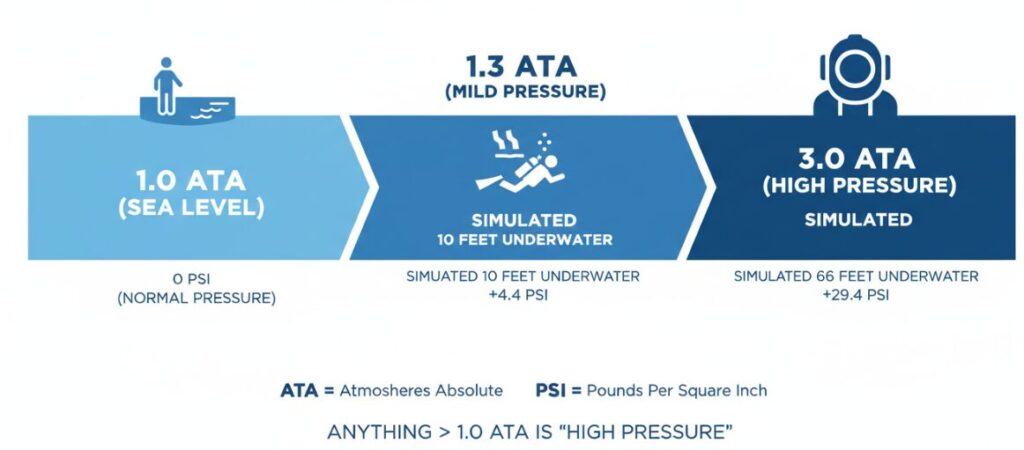
To really understand the pressure in the cabin, you must understand the ATA(Atmospheres Absolute, absolute atmospheric pressure) this unit.
At sea level, the weight of the atmospheric pressure on the human body is defined as 1.0 ATA. When converted to pounds per square inch (psi),1 ATA is approximately 14.7 psi. When you walk into a hyperbaric chamber, the pressurization of the internal environment is superimposed upward on this basis.
1.3 ATA: The ambient pressure is 30% higher than sea level.
2.0 ATA: equivalent to twice the atmospheric pressure at sea level.
3.0 ATA: equivalent to three times the atmospheric pressure at sea level.
It is the elevation of ATA that constitutes the fundamental mechanism of hyperbaric oxygen therapy (HBOT), which is also the essential difference between it and you inhaling oxygen at normal pressure.
Pressure Differences For Different Cabin Types
Not all hyperbaric chambers reach the same pressure level. How much pressure the cabin can withstand directly determines its classification and use.
1. Light And Non-Medical Oxygen Chamber (1.3 ATA – 1.5 ATA)
The so-called “mild” hyperbaric chambers are usually referred to as soft-shell chambers, which operate at the lower end of the pressure spectrum. These portable units have significant limitations compared to medical devices:
Upper pressure limit: Usually limited to 1.3 to 1.5 ATA.
PSI conversion: This means that the internal pressure is only about 4 to 7 psi higher than the standard atmospheric pressure.
Application scenario: Due to the low pressure, this type of cabin is mainly used for off-label purposes, such as lactic acid removal after exercise, general health care or relief of mild altitude sickness. They are designed for home use or health center safety, and simply cannot meet the high-pressure standards required by hospitals to handle critical illness.
To the forefront of nutrition
HE5000
2.0ATA, Medical grade pressure is suitable to home health, Dimensions: 82 x 65 x 72 inch for 1-3 person using.
HE5000
HE5000-Plus
2.0ATA, Medical grade pressure is suitable to home health, Dimensions: 102 x 65 x 72 inch for 1-4 person using.
HE5000-Plus
Diamond-100
2.0ATA, Medical grade pressure is suitable to assist in the treatment of disease, diameter 39inch for two adults using.
Diamond-100
2. Medical Grade Hardware Cabin (2.0 ATA – 3.0 ATA)
Medical-grade oxygen chambers must be made of rigid materials such as steel and acrylic to withstand huge physical forces.
Pressure Capability: These devices can maintain pressures between 2.0 ATA and 3.0 ATA.
PSI conversion: When 3.0 ATA, the pressure is about 44.1 psi, which is a huge improvement over the standard sea level 14.7 psi.
Application scenario: This high-pressure environment is essential for dealing with serious medical emergencies. For example, to treat decompression sickness or necrotizing infection, we need deep compression to physically shrink the air bubbles, or to force oxygen into the damaged tissue at a rate that a mild cabin can’t reach.
The Importance Of High ATA
The specific pressure range chosen to 1.3 to 3.0 ATA is not arbitrary, but is rooted in physics. The success or failure of treatment depends entirely on how the human body responds to high pressure according to those two basic gas laws.
Henry’s Law And Oxygen Saturation
Henry’s law states that the amount of gas dissolved in a liquid is proportional to the partial pressure of that gas.
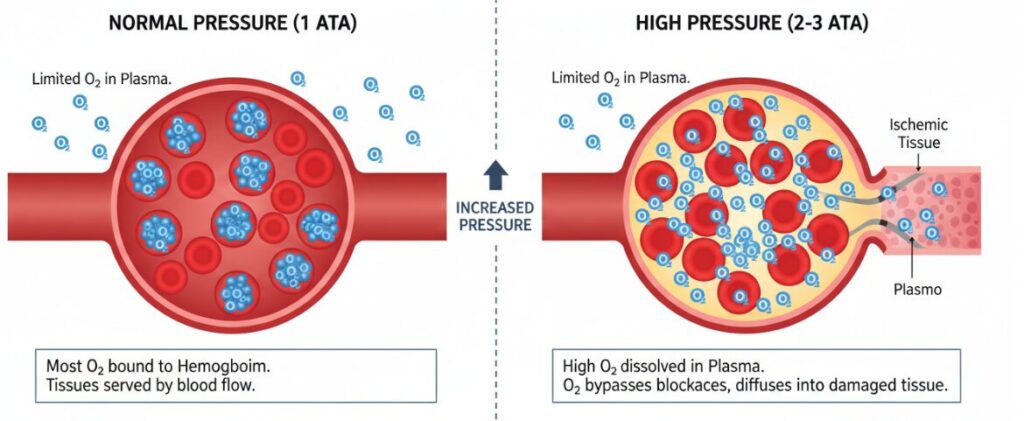
At a normal atmospheric pressure of 1 ATA, oxygen is mainly transported by hemoglobin in red blood cells, which is almost “full” at this time. But when we raise the cabin pressure to 2.0 or 3.0 ATA, Henry’s Law begins to work its magic. High pressure forces oxygen to dissolve directly into the plasma, cerebrospinal fluid and lymph.
This allows oxygen to bypass the blocked blood vessels and penetrate directly into the ischemic damaged tissue-even when blood flow is restricted. This level of oxygenation is absolutely impossible to achieve at sea level and atmospheric pressure.
Boyle’s Law And Gas Volume
Boyle’s law states that the volume of a gas is inversely proportional to the surrounding pressure. The greater the pressure, the smaller the gas volume.
This principle is the key to saving lives when dealing with conditions involving “gas retention”, such as decompression sickness (commonly known as diver’s disease) or arterial gas embolism. By increasing the chamber pressure to 2.8 or 3.0 ATA, we can significantly reduce the physical size of the nitrogen gas bubbles in the blood. This reduction in volume relieves blood vessel blockage and allows the gas to be re-absorbed by the body and safely discharged.
Author:Jane
With over a decade of experience in hyperbaric technology, I specialize in chamber safety standards and pressure protocols. I hope to demystify the science of ATA and psi, helping you understand how specific pressure levels in mild and medical-grade chambers drive therapeutic results.